What is Reinforcement Learning?
In the world of AI, trying to copy how humans learn has led to reinforcement learning (RL). At its core, reinforcement learning basics are about AI models learning through a system of rewards, similar to how humans learn. Through trials, mistakes, and successes in changing environments, reinforcement learning agents find ways to achieve their goals. They balance between actions and results.
This method is different from other learning methods where agents just receive information. Reinforcement learning agents actively look for the best path to take. They make choices that improve their ability to make decisions in an interactive world. This showcases adaptive and smart behavior that pushes AI forward.
But what does this mean in real life? How does a machine learn by reinforcement and how does it change the future of AI? To get this, one needs to explore reinforcement learning basics. We must look into the clever algorithms that learn through experience and adjusting to new information.
Key Takeaways
- Reinforcement learning is a form of AI learning models where agents learn to make decisions through trial and error.
- Unlike other learning paradigms, reinforcement learning agents proactively seek to maximize rewards and minimize punishments.
- Through interaction with a dynamic environment, these agents adapt their actions to achieve specific goals.
- This form of learning is similar to biological processes and can be applied to a wide array of AI challenges.
- Understanding reinforcement learning fundamentals is critical to grasping the future trajectory of AI progress.
Understanding the Basics of Reinforcement Learning
What’s at the heart of reinforcement learning? It’s a type of machine learning algorithm that trains software to make choices. They learn this by interacting with their surroundings. Rather than needing direct instruction, reinforcement learning allows agents to learn from the outcomes of their actions. This approach helps them understand how to act optimally over time.
The beauty of reinforcement learning lies in its feedback system. It rewards actions that lead to good results, encouraging them to happen again. Meanwhile, it deters actions that have bad outcomes. This reward-based method, often tied to a Markov decision process, is key to its success.
To truly grasp machine learning algorithms, it’s vital to understand reinforcement learning. The fundamental concepts outlined next form its backbone.
Definition of Reinforcement Learning
In simple terms, reinforcement learning is about an agent learning to maneuver through trial and error. It relies on feedback from its actions and experiences, not preset data.
Key Terminology in Reinforcement Learning
- Agent: The actor within the environment, learning and changing its behavior based on feedback.
- Environment: Where the agent operates, including all challenges and objectives it encounters.
- Policy: The strategy an agent uses, linking what it sees to the actions it should take.
- Value Function: It predicts future rewards, helping to identify beneficial states for the agent.
- Reward: Feedback the agent gets from its actions, steering it towards good outcomes.
Together, these elements help software agents not just to act, but to excel. They continually fine-tune their strategies to meet long-term goals. This cycle of learning and adapting is why reinforcement learning is crucial to advancements in various fields, including robotics and self-driving cars.
The History and Evolution of Reinforcement Learning
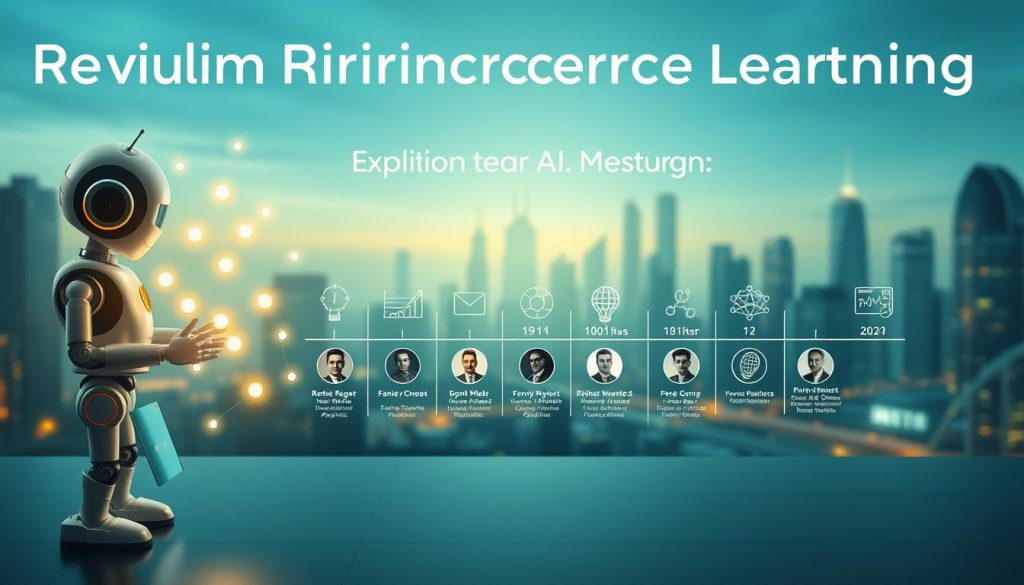
The journey of reinforcement learning is quite the story, starting from academic curiosity and moving to practical use. It all began with early research that really shaped what this field is today.
Pioneering Contributions in the Field
This area has grown thanks to big steps forward in AI learning models. Such growth came from researchers trying to get a grip on how machines learn. Ideas like dynamic programming laid the foundation. They paved the way for developing machine learning algorithms with step-by-step solutions.
Significant Milestones in Algorithm Development
Reinforcement learning has hit many key milestones over the years, changing the game. One big leap was the Monte Carlo methods. They brought randomness into learning, making AI models stronger and more flexible.
Then, temporal difference learning combined Monte Carlo’s insights with dynamic programming. This blend led to smarter learning abilities. These breakthroughs didn’t just improve AI models. They deepened the methods behind today’s machine learning algorithm development.
Core Concepts of Reinforcement Learning
In the world of artificial intelligence, especially reinforcement learning (RL), grasping key ideas improves AI decision-making. This part explores the main roles of agents and environments, plus the rewards and penalties system. It also covers the critical choice of exploring versus exploiting, which shapes the behavior and success of RL systems.
Agents, Environments, and Actions
Agents make the decisions in RL systems. They see and react to their surroundings, aiming for specific achievements through actions. This interaction depends on the data they collect and use to make wise choices, often to get the most reward over time.
An environment is where an agent works. It might be a computer game’s virtual world or the surroundings for self-driving cars.
Rewards and Punishments
In RL, rewards and punishments are vital. They offer feedback from the environment, guiding the learning of agents. Rewards make it more likely for an action to be repeated if it leads to good results. On the contrary, punishments decrease unwanted actions, bettering decision-making and action efficiency by the AI.
The Exploration vs. Exploitation Dilemma
The dilemma of exploration versus exploitation is key for RL systems. Exploration means agents try new things to learn more about their world. It’s about finding higher reward strategies. Exploitation uses what’s already known to make the best decisions based on current info. Balancing these strategies determines the success of RL efforts, affecting AI’s ability to adjust or optimize its strategies.
To wrap up, reinforcement learning’s main ideas revolve around agent-environment interactions and learning from actions, driven by rewards and penalties. Successfully balancing exploration and exploitation is crucial for improving AI decision-making processes. Understanding and applying these concepts allow RL applications to excel in various fields.
Types of Reinforcement Learning
In the exciting world of deep reinforcement learning, it’s key to know the different methods. We will look at the main types of reinforcement learning. We will also see how they work and where they are used.
Reinforcement learning splits into two main strategies: model-based and model-free. Choosing the right one depends on the data you have. It also depends on how precise your decisions need to be.
| Approach | Definition | Benefits | Use-case Examples |
|---|---|---|---|
| Model-Based | Uses a model of the environment to simulate outcomes to forecast future states. | Precise planning, efficient in predictably stable environments. | Manufacturing processes, trajectory planning in robotics. |
| Model-Free | Learns directly from real or simulated interaction without assuming knowledge of the environment. | Flexibility, ideal for complex and non-stationary environments. | Video game AI, real-time problem-solving. |
We also split RL techniques into policy-based and value-based groups. These groups guide decisions in RL systems. Actor-critic methods mix both, offering the best of each method. This makes them great for complex RL tasks.
| Strategy | Core Mechanism | Advantage | Example Applications |
|---|---|---|---|
| Policy-Based | Improves action decision policy directly through experience. | Simple implementation, effective in high-dimensional or continuous action spaces. | Autonomous driving systems, personalized advertising. |
| Value-Based | Focuses on maximizing a value function that estimates future rewards. | Stability and convergence, suitable for discrete and deterministic environments. | Board games like chess, routine task automation. |
| Actor-Critic | Combines policy and value-based aspects to stabilize the training process. | Efficient learning rates, beneficial in complex scenarios where both aspects are needed. | Advanced robotics, stock trading algorithms. |
Choosing the right RL strategy depends not just on technology. It also must fit the specific needs and goals of your task.
Key Algorithms in Reinforcement Learning
In the world of reinforcement learning, some algorithms really shine. They lead the way in teaching AI to make decisions and learn on its own. We’re talking about Q-learning, Deep Q-Networks (DQN), and Proximal Policy Optimization (PPO) here. Each one brings something special to the table, especially when the task gets tough and demands smart, predictive decisions.
Q-learning Techniques: At its core, Q-learning looks at the ‘quality of actions.’ It lets AI agents act without a set plan, aiming to grab the maximum rewards. They update their ‘Q-values’ after seeing what rewards come their way. This method helps them figure out which moves work best, getting better after each attempt.
Deep Q-Networks (DQN): DQN takes Q-learning up a notch by bringing in deep neural networks. This setup is great at handling complex visual info. DQN shines in robotics and gaming, where older methods just can’t keep up. It’s known for learning from massive, detailed datasets, marking a major leap in AI tools used in deep reinforcement learning.
Proximal Policy Optimization (PPO): PPO is another step forward, making the training of AI smoother and more effective. It cleverly balances trying new things and sticking with what works. This prevents big swings in AI behavior that could mess things up.
Applications of Reinforcement Learning
Reinforcement learning (RL) has changed many fields with its smart learning methods. These are powered by advanced neural networks. This section talks about three main areas where RL has done well.
Robotics and Automation
In robotics, RL lets machines learn on their own from the environment. This makes them more efficient and effective at tasks. Robots now do precise assembly work or even deliver packages as autonomous drones. RL makes robots better by learning from trial and error. They do this without needing people to help, moving us closer to full automation.
Game Playing and AI Competitions
In AI contests, RL has become very important. Neural networks now beat human players in games like Go and Chess. RL lets these systems try many strategies, making them tough competitors. This shows how AI can handle complex decisions, just like in real life.
Real-World Decision Making
RL is very useful for making decisions in the real world. It can improve logistics, supply chains, or even personalize online content. RL algorithms handle lots of data to make immediate, smart choices. This is great for industries that need to be both accurate and flexible.

Challenges in Reinforcement Learning
In the field of reinforcement learning (RL), we face big challenges. These issues impact how effective RL algorithms are. We look into several key problems, like how RL systems can learn better in real-world situations. We will talk about data usage, stability, and how well they can adapt.
Data efficiency is a big problem, especially in how RL learns from its actions. If a model can learn with less data and still do well, it’s very useful. This is important when it’s hard or costly to get more data.
The stability of RL algorithms is another issue. They need to not only find the best solutions but also keep performing well. If they don’t stay stable, they might act unpredictably. This can make people lose trust in these systems.
Lastly, we need to talk about generalization. It’s a challenge when models do great in practice but not in new situations. Overcoming this needs methods that help the model adjust and do well in different scenarios. This is important to make sure the models are really useful.
Looking at these challenges helps us understand what we need to do to improve RL algorithms. We need to tackle each problem, from using data better to adapting to new situations. This needs careful study and creative solutions. Only then can RL be more reliable in the technology we use every day.
Future Trends in Reinforcement Learning
Reinforcement learning (RL) is growing fast, thanks to teaming up with various AI tools. This teamwork is pushing AI to be more self-reliant and adaptable. Let’s explore how these changes might reshape reinforcement learning in the future.
Combining RL with other machine learning methods is key to improving RL systems. By doing this, AI agents can better understand and use a wider range of data. This not only boosts their performance but also speeds up their learning, meeting increasing needs in both industry and research.
Transfer learning is a big step forward for RL. It lets useful knowledge from one area be applied to another, saving training time and resources in new settings. This is especially useful for complex projects that need a lot of computing power and data.

The use of AI tools and how they’re applied in RL is also under ethical review. As algorithms grow stronger, the need to use them responsibly and transparently is more important than ever. Addressing ethical issues is key to building trust and advancing RL applications healthily.
Together, these trends point to a future where AI tools and ethical considerations make RL central to solving real-world issues efficiently. Blending RL with advanced AI like policy optimization and other algorithms promises to open new possibilities in many fields.
Tools and Frameworks for Reinforcement Learning
The growth of AI largely relies on strong tools and frameworks. Developers have key resources like OpenAI Gym, TensorFlow Agents, and Ray RLLib for learning reinforcement learning. These tools are essential for creating effective AI models. They help in understanding and using reinforcement learning techniques better.
OpenAI Gym is crucial for beginners and experts to improve their models. It offers various environments that mimic real-world scenarios. This is perfect for testing and enhancing AI agents’ performance.
TensorFlow Agents (TF-Agents) simplifies the creation and testing of machine learning algorithms. It’s not just for deep reinforcement learning. The library includes modular pieces for different RL applications. This increases model flexibility and adaptability.
Ray RLLib addresses large-scale reinforcement learning issues. It enhances scalability and accessibility. With support for many RL algorithms, it serves both research and practical needs.
| Feature | OpenAI Gym | TensorFlow Agents | Ray RLLib |
|---|---|---|---|
| Primary Use | Benchmarking RL models | Building and experimenting | Scalable RL training |
| User Friendliness | Excellent for beginners | User-friendly with extensive documentation | Designed for use at scale |
| Customizability | Limited compared to others | Highly customizable | Adapts to complex environments |
| Community Support | Large community | Supported by TensorFlow community | Broad support for various RL needs |
Using these tools, AI developers can explore new possibilities in AI learning. They drive innovation and improve efficiencies in reinforcement learning applications. These frameworks ensure that learners can navigate reinforcement learning with confidence. They are useful for both academic and practical purposes.
Resources for Learning Reinforcement Learning
Starting to learn reinforcement learning can change your life, thanks to many great resources. It’s important to understand these AI educational resources well. This is especially true because AI and creating its algorithms are complex.
Recommended Books and Texts
Reinforcement learning books are key for both newbies and experienced learners. They cover complex topics and the basics of AI learning models, making tough ideas easy to get. Also, they feature case studies from the last 12 years, showing real-world uses and industry impacts.
Online Courses and Tutorials
Online reinforcement learning courses are perfect for those who like learning with others. They’re made for all learning speeds and offered by trusted education sites. These courses have pre-recorded and live classes, letting you talk directly with teachers and classmates for a better grasp of topics.
Community Forums and Conferences
Being active in the community helps you keep up with new trends and shifts in the field. Community forums and yearly conferences are great for meeting people, sharing knowledge, and discovering new things with both experts and new learners. Joining these groups gives you insights into the latest studies and how reinforcement learning is used globally.

- Comprehensive guidebooks on reinforcement learning
- Specialized webinars and hands-on workshops
- Participation in open-source projects and hackathons
Clearly, there’s a lot of ways for those interested to dive deeper into reinforcement learning. This opens it up to more people and promotes the sharing of knowledge and ideas.
Conclusion: The Impact of Reinforcement Learning on the Future
Reinforcement learning has taken machine learning to new heights. It’s now a key part of how AI systems get smarter on their own. They learn from mistakes and successes, just like we do. This shows the creativity behind AI’s growth.
Reinforcement learning is really changing the game for AI’s future. Deep reinforcement learning, especially, is breaking through tough challenges. We’re seeing its effects in robotics, video games, and making strategies. This shows us that smarter, more adaptable machines are coming.
We expect reinforcement learning to bring even more amazing things. Machines will get better at understanding and reacting to the world around them. The idea of machines improving themselves is getting real. Though it brings challenges, reinforcement learning’s role in AI is unwavering. It’s leading us to discoveries we can hardly imagine yet.
FAQ
What is Reinforcement Learning?
What are the key concepts and terminology in Reinforcement Learning?
How has Reinforcement Learning evolved over time?
What distinguishes Reinforcement Learning from Model-Based and Model-Free Learning?
What is Q-Learning and how is it significant in Reinforcement Learning?
How is Reinforcement Learning applied in the real world?
What are some challenges faced by Reinforcement Learning?
What future trends are emerging in Reinforcement Learning?
What tools and frameworks support Reinforcement Learning development?
Where can I find resources to learn more about Reinforcement Learning?
What impact will Reinforcement Learning have on the future?
About the author : virtual-glasses