Can AI Improve Itself?
When Mark Zuckerberg, CEO of Meta, talks about AI beating human smarts, we should listen. AI self-optimization isn’t just big talk. It’s crucial for AI to grow, pushing tech to new heights. But as AI gets better on its own, we face big questions about ethics and safety. Companies like OpenAI, Google’s DeepMind, and Anthropic are not just making smart programs. They’re crafting beings that could solve big human problems and change how they work.
AI getting better by itself is now real, shown by advances in coding and chip design. Can AI become so good it’s essential in our progress, or might it bring unknown dangers? Meta’s hunt for top researchers and DeepMind’s breakthroughs point to a future where human and AI smarts merge. This blend will push both even further.
Key Takeaways
- Mark Zuckerberg’s vision for Meta includes AI surpassing human capabilities through self-improvement.
- AI self-optimization is key to artificial intelligence evolution, with significant contributions to efficiency and problem-solving.
- Leaders in AI research like OpenAI, Google’s DeepMind, and Anthropic are focusing on automated AI systems for safety and advancement.
- Tangible examples of AI self-improvement include automated code generation and chip optimization technologies.
- The convergence of human talent and AI’s self-upgrading ability is rapidly shaping the future of technological development.
Understanding AI Self-Improvement
AI self-improvement means artificial intelligence systems get better on their own. These systems not only do routine tasks but also grow to solve tougher problems. It’s vital to know how they improve themselves, changing their AI systems and getting smarter.
AI becomes better in many ways, from tweaking algorithms to big system changes. They learn from vast amounts of data, getting better without needing people. This self-driven improvement is key.
What is Self-Improvement in AI?
Self-improvement in AI is when AI systems refine their own algorithms autonomously. This is what makes advanced AI stand out from simple programs. With machine learning and deep learning, they make their decision-making sharper, pushing AI self-improvement far ahead.
The Mechanisms Behind AI Learning
Key aspects drive AI learning and getting better. Including machine learning models that adapt from feedback, and tech that boosts processing and accuracy. These strategies help AI achieve more, raising their value and role in real life.
| Feature | Description | Impact on AI Capability |
|---|---|---|
| Algorithmic Self-Optimization | AI systems autonomously refine their algorithms for better performance. | Improves accuracy and speed of AI decision-making processes. |
| Neural Network Advances | Development of deeper, more complex neural network structures. | Enables AI to handle more complex tasks and improve learning from data. |
| Data Efficiency Improvement | AI optimizes its data processing techniques to use fewer resources. | Reduces operational costs and accelerates AI training processes. |
AI systems that can change themselves show how AI can not just do tasks but also invent new solutions. This opens up new chances for neural network growth, taking AI’s potential further.
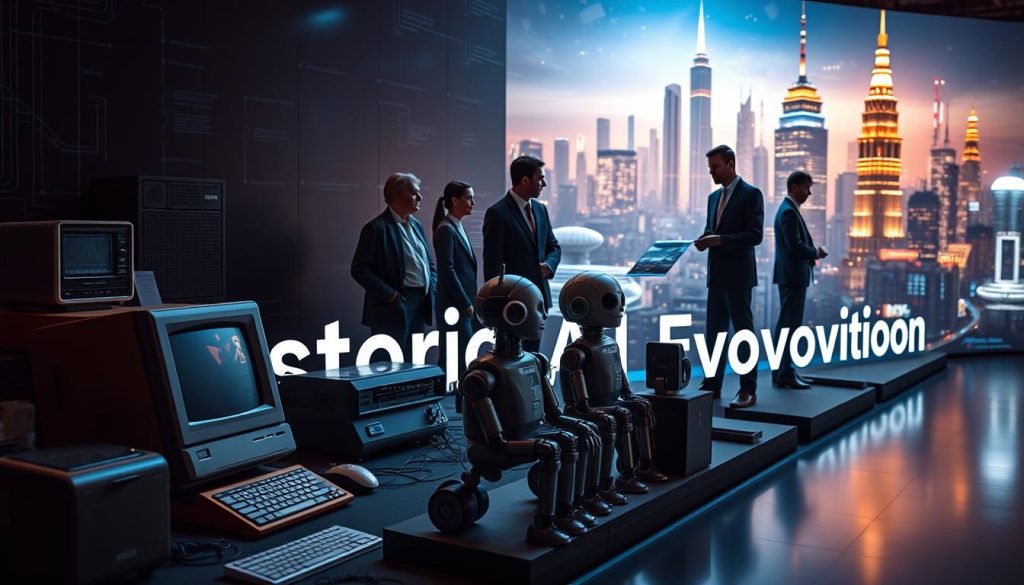
Historical Background of AI Evolution
Exploring the history of artificial intelligence (AI) is truly captivating. It shows us how the growth in AI, the development of AGI (Artificial General Intelligence), and the journey towards superintelligence are closely linked. Starting with early systems, AI’s landscape has changed dramatically over time.
Pioneering AI Systems
The start of AI technology brought a big shift in how computers work. Early AI was made to copy human thinking, like solving problems and learning. This era was the beginning of machine learning, leading to new breakthroughs that made AI smarter and faster.
Milestones in Self-Improvement
In 2017, the creation of transformer architectures marked a big moment for AI. These approaches made machines much better at understanding and creating language. This development pushed AI forward, moving us closer to making AGI a reality.
Also, the creation of things like the Darwin Gödel Machine brought major improvements. These improvements are about changing themselves to get better, which has sparked a lot of research into making AI that can think and improve like we imagine superintelligence will.
| Year | Milestone | Impact on AI Evolution |
|---|---|---|
| 2017 | Introduction of Transformer Architectures | Enhanced natural language processing capabilities |
| 2021 | Development of Darwin Gödel Machine | Initiated new approaches in AI self-modification |
Machine Learning: The Heart of AI
Machine learning sits at the heart of artificial intelligence. It’s a buzzing field that powers today’s AI breakthroughs. With machine learning, applications can become more efficient over time. This improvement happens without people having to oversee it, thanks to machine learning self-enhancement.
When we dive into machine learning, we find two main types: supervised and unsupervised learning. These types are key for AI to grow. They help AI understand and use data to make smart choices.
Types of Machine Learning
- Supervised Learning: Here, an AI system is taught using a dataset where every input matches a known output. The model gets better as it processes more labeled data, aiming to make fewer mistakes and boost its ability to predict correctly.
- Unsupervised Learning: This type works with data that doesn’t have labels. The aim is for the AI to find patterns and links on its own. This approach drives neural network advancement and helps in uncovering new insights.
Supervised vs. Unsupervised Learning
| Feature | Supervised Learning | Unsupervised Learning |
|---|---|---|
| Data Requirement | Labeled data | Unlabeled data |
| Main Objective | Predictive accuracy | Pattern discovery |
| Complexity | High (due to need for labeled datasets) | Varies (often less than supervised) |
| Applications | Classification and regression tasks | Clustering and association tasks |
Both supervised and unsupervised learning are transforming technology. They’re vital for machine learning in AI. As they evolve, these learning types expand what machines can do. They’re pushing us closer to achieving true AI intelligence.
The Role of Data in AI Improvement
Data plays a key role in advancing artificial intelligence. It is the foundation for AI to learn and grow, determining how these systems progress. High-quality, large amounts of data improve AI’s decision-making abilities.
Data Quality and Quantity
The better and more data AI has, the better it works. AI needs a lot of varied and complex data to improve its predictions. When there isn’t enough real data, new methods are created to fill the gap.
Ensuring rich data inputs is tantamount to equipping AI with the tools necessary for substantial cognitive and functional growth.
Real-Time Learning Mechanisms
Real-time data use is a big step in AI improvement. AI systems learn and adjust non-stop, showing how they can evolve. For instance, some AI changes its processes based on what users do and say, adjusting to new situations.
- Iterative refinement and adaptation of strategies
- Integration of new data into AI models in real-time
- Enhanced responsiveness to changes in data patterns
AIs that constantly update stay useful in a world that’s always changing.

Algorithms: The Building Blocks of AI
Algorithms are crucial for the power of artificial intelligence. They lay the groundwork for AI to understand and handle large amounts of data. This lets AI systems perform complex tasks very accurately. As these algorithms get better, self-changing AI systems play a bigger part. They push AI to adapt and react to new data on its own.
How Algorithms Adapt and Evolve
Adaptation and evolution in AI usually come from methods like reinforcement learning. In this method, AI learns from both success and failure. It then changes its actions based on what it has learned before. This ongoing adjustment improves AI’s performance and helps it deal well with unexpected situations.
Notable Self-Optimizing Algorithms
Google’s AlphaEvolve is a great example of a self-improving algorithm. It lets an AI upgrade its own algorithms, leading to better performance. This kind of self-changing AI system has brought a lot of progress. It’s used in many areas, from managing energy to automating processes. This shows the big impact that continuous improvement of algorithms can have.
The Concept of Reinforcement Learning
At the heart of advanced AI growth is reinforcement learning. It’s a key method that helps AI get better on its own. By rewarding or penalizing AI systems based on their actions, they learn from their experiences. Their main aim is to make better decisions to get the best results.
Reinforcement learning is a unique approach for AI to improve itself. It lets AI get better over time by trying and learning from mistakes. This way, AI becomes more efficient and accurate at tasks. It adapts to new information and changing situations without needing people.
The Basics of Reinforcement Learning
Reinforcement learning works by letting AI make choices, one after another. It gets feedback through rewards or consequences and learns to make better choices. The AI system uses this feedback to tweak its approach to achieve more good outcomes.
Applications in Self-Improvement
Reinforcement learning is used in many ways to help AI improve itself in various areas. It’s used in simple jobs like automation in factories and in complex tasks such as improving chip designs and software functions. It’s even used to better train other AI models, making them learn faster and perform better.
- Automated decision-making in financial trading
- Dynamic routing and scheduling in logistics
- Personalized learning paths in educational technologies
- Enhanced user experience in interactive applications
Through reinforcement learning, AI systems can grow and explore new possibilities. They help advance AI self-improvement technologies. These technologies could one day automatically solve some of technology’s toughest challenges.
Current Examples of AI Self-Improvement
When we look at AI systems that improve themselves, big steps forward are pretty clear. We’re diving into how self-driving cars and voice-activated helpers are getting better on their own. These areas show how AI is making things safer and easier for us.
Self-driving cars are a top example of AI getting smarter. These cars get better at making driving decisions by analyzing tons of data. This learning makes travel more efficient and safer, especially when navigating on their own.
Voice-activated assistants are changing how we use devices. They learn from talking to us, getting better at providing the right answers. They learn what we like and customize their help, making life a bit easier.
| Feature | Self-Driving Cars | Virtual Personal Assistants |
|---|---|---|
| Learning Method | Continuous data from sensors and cameras | User interaction and spoken commands |
| Improvement Focus | Safety and navigation efficiency | Response accuracy and personalization |
| Benefits | Reduces human error in driving, provides comfort | Increases efficiency in tasks, enhances user experience |
AI systems that can update themselves are changing many industries. As AI keeps getting smarter, we can expect even more incredible improvements. This is leading towards technology that’s more helpful and better able to think on its own.
Challenges in AI Self-Improvement
The path to AI self-enhancement is littered with difficult obstacles. Ethical AI development and technical challenges are key. As we give AI more freedom, AI self-improvement risks and ethical questions grow. This demands a careful mix of innovation and control.
Ethical considerations highlight big worries about AI misuse. Important ethical problems arise with AI used in watching people, in the military, and for changing data. These issues spark vital talks on AI’s limits.
Technically, the roadblocks are just as tough. AI, despite its abilities, struggles with complex algorithms and massive data processing needs. These technical limitations slow down and limit AI progress, making real self-improvement hard soon.
“Balancing AI self-improvement risks with responsible innovation is the cornerstone of ethical AI development.”
| Challenge Type | Description | Impact on AI Development |
|---|---|---|
| Ethical Dilemmas | Ethical concerns about privacy, autonomy, and misuse. | May impede adoption and trust in AI systems. |
| Technical Hurdles | Complex algorithms and substantial computational needs. | Limits the practical implementation of self-improving AI. |
Handling these issues means ethical AI development talks are key. Ensuring tech advances fit with our values and norms is important. Also, facing AI self-improvement risks with proactive plans will guide AI’s future direction.
The Future of AI Self-Improvement
AI’s quick progress is both exciting and challenging as we think about technology’s future. There are several forecasts about where AI is heading. These show how deeply it will affect many social areas.
Predictions and Trends
Experts predict AI will become more independent, needing less help from humans. There’s a mix of hope and worry about AI reaching superintelligence. Such advances could make AI better understand and interact with our world, pushing machines beyond today’s abilities.
Potential Impact on Various Industries
AI is set to bring big changes across fields like healthcare, finance, and manufacturing. In healthcare, it could quickly analyze patient data for quicker, more correct diagnoses. Finance could see AI making better market predictions and investment advice. And in manufacturing, AI might boost efficiency and allow more product customization.
- Healthcare: Revolutionizing diagnostic and treatment processes
- Finance: Enhanced predictive capabilities for market analysis and investment strategies
- Manufacturing: Greater efficiency and customization in production technologies
As AI advances, its benefits and challenges will keep changing. This means we need ongoing research and talks to deal with these complex changes. It’s vital to keep a careful balance between innovating and sticking to ethical standards. This way, AI can help society without messing with our core human values.
AI and Human Collaboration
Advances in artificial intelligence (AI) are changing not only technology but also how we improve our abilities. AI and humans working together is key to this big change. It shows a partnership that makes both better. Working together, AI and humans learn from each other. This opens new paths for growth in many areas.

Enhancing Human Decision-Making
When we add AI to making decisions, it greatly helps our thinking. AI tools use lots of data and patterns to give new insights and advice. This makes decisions quicker and more right on target. It shows how using data can solve tough challenges.
Co-Evolution of AI and Human Intelligence
AI and human smarts growing together means a future where both learn from each other. AI learns from what people do and say. People pick up new ways of thinking from AI. This back-and-forth growth makes both AI and human intelligence get better together.
Looking at projects like Google DeepMind’s AI Scientist, we see AI and humans becoming more connected. Anthropic’s Constitutional AI project is also making sure AI works well and ethically with humans. These efforts help make sure AI helps us in work and life.
As AI gets better, it plays a bigger role in making human decisions better too. It can even help manage our lives and health better, as many users have found. AI working with humans not just boosts our skills now. It also promises a future where we keep getting better, thanks to smart technology.
Conclusion: The Journey Ahead for AI
Technology’s fast pace hints at a future where AI systems change all parts of our lives. We are at the start of a tech revolution. It’s essential to understand what self-improving AI means for everyone.
There are big chances for new things and better ways of doing stuff. But we also need to think about how to make AI safe and fair. AI growth must be ethical and good for all people.
Implications of Self-Improving Systems
Self-improving AI means these systems will get better on their own. This can make them solve problems faster and think more freely. It’s a mix of exciting and worrying possibilities.
We might have less boring work and do more creative things. But, we need to be careful with AI making its own choices. It’s important that AI helps everyone and doesn’t cause harm.
The Roadmap for Responsible AI Development
To move forward with AI, everyone from creators to lawmakers must plan for the future. They must work together for safe AI growth. This plan should include ethics and talk with the public.
Rules and guides will help AI do good things and avoid problems. With AI growing fast, setting these guidelines early is very important. A thoughtful approach will make sure AI improves our world for everyone.
FAQ
What is Self-Improvement in AI?
What are the Mechanisms Behind AI Learning?
What were the Pioneering AI Systems?
What are Milestones in Self-Improvement?
What are the Types of Machine Learning?
What is the difference between Supervised and Unsupervised Learning?
How important are Data Quality and Quantity for AI?
What are Real-Time Learning Mechanisms?
How do Algorithms Adapt and Evolve in AI?
What are some Notable Self-Optimizing Algorithms?
What are the Basics of Reinforcement Learning?
What are the Applications in Self-Improvement?
How are Self-Driving Cars an example of AI Self-Improvement?
In what ways do Virtual Personal Assistants demonstrate AI Self-Improvement?
What are the Ethical Considerations in AI Self-Improvement?
What Technical Limitations do Self-Improving AI Systems face?
What are the Predictions and Trends for the Future of AI Self-Improvement?
What could be the Potential Impact of AI on Various Industries?
How does AI Enhance Human Decision-Making?
What is meant by the Co-Evolution of AI and Human Intelligence?
What are the Implications of Self-Improving AI Systems?
What is the Roadmap for Responsible AI Development?
About the author : virtual-glasses