How Do People Use AI Daily?
Artificial Intelligence (AI) has moved from sci-fi movies to our daily lives. How do people use AI daily? More often and easily than we think. Now, AI makes our morning routines and home appliances smarter. It changes how we have fun, handle money, and even the way we get healthcare and work productively.
A world where convenience and efficiency matter greatly is upon us. We use AI devices and systems every day. They learn from us, predict what we need, and make life organized and simpler. Your smartphone might remind you to take an umbrella, or your thermostat could adjust the temperature for you. AI is quietly transforming modern living in incredible ways.
Key Takeaways
- The invisible yet integral role of AI in enhancing everyday life
- AI’s transformation of personal convenience and home efficiency
- How virtual assistants and smart homes are a testament to AI’s practical uses
- The broader impact of AI on sectors like healthcare, finance, and productivity
- Understanding AI’s seamless integration into daily routines
The Ubiquity of AI in Everyday Life
Today, everyday applications of artificial intelligence are changing our homes. They make our living spaces efficient and tailored to us. AI technology at home shows us how well technology and daily life can mix.
The creation of home assistants and voice recognition has been a big step. Devices like Amazon Alexa, Apple Siri, and Google Assistant show what AI can do for consumers. They let users manage their surroundings with just their voice. These devices not only make life easier but also help those with physical challenges.
Home Assistants and Voice Recognition
Intelligent assistants lead the way in using artificial intelligence every day. They make daily routines interactive and personal. Voice recognition tech has gotten really good at understanding and acting on what people say accurately.
Smart Home Devices and Automation
AI in homes is also improved by smart devices like thermostats, lights, and security cameras. These gadgets adjust to your habits to make your home fit your needs automatically. The table below shows some common smart home gadgets. They use AI to automate and personalize.
| Device Type | Function | AI Feature |
|---|---|---|
| Smart Thermostat | Temperature Control | Learning user’s temperature preferences and schedule |
| Smart Lighting | Lighting Automation | Adjusting brightness based on time of day and presence |
| Security Camera | Home Security | Facial recognition and motion detection |
In the end, the growth of consumer AI tools shows a big change in home technology. These advancements make managing a house easier and totally change home life.
AI in Communication Tools
AI has made chat and email tools much better for talking to friends or working. By adding AI personal assistants and smart tech, these tools help us get more done every day.
Email filtering and smart replies are smart ways AI helps us every day. They sort emails for us, putting important ones first and keeping spam away. AI also creates quick, smart answers, helping us keep in touch easily but still sounding like us.
| Feature | Benefits | User Impact |
|---|---|---|
| AI-Enabled Email Filtering | Reduces spam, highlights important emails | Time-saving, enhances focus |
| Smart Reply Generation | Quick responses, context-aware | Boosts reply efficiency, maintains engagement |
AI-driven chatbots are changing how businesses talk to customers. They are always ready to chat, thanks to AI understanding and answering like a human. Businesses use these chatbots for better, round-the-clock help, making customers happier and work smoother.

With AI in our communication apps, talking and working every day is easier and better. AI keeps getting smarter, making our digital talks and work even more efficient. The future of chatting and emailing is exciting with AI.
Personal Finance Management with AI
AI technology is becoming a big part of our homes, especially for managing money. It makes tools smarter, helping us budget, track spending, and invest wisely.
With AI, budgeting tools auto-sort transactions, making it easy to keep up with money. This saves time and helps us figure out our spending habits. It leads to better planning.
AI also changes how we invest by predicting stock market trends. It uses big data to offer investment tips quickly and accurately. This gives investors a big edge in making smart choices.
| Feature | Description | Benefit |
|---|---|---|
| Automated Expense Tracking | AI systems categorize transactions and track spending. | Reduces manual entry errors and saves time. |
| Financial Insights | AI analyzes spending habits and gives personalized financial advice. | Helps users optimize their financial health. |
| Investment Prediction | Utilizes historical data and trends to forecast stock performance. | Empowers users with foresight to manage investments effectively. |
Overall, AI doesn’t just make managing money easier. It also helps us make smarter decisions with our money. We can do better in finances thanks to AI.
AI in Healthcare: Improving Patient Care
Healthcare AI is changing how we take care of patients, making things more specific to each person. AI helps doctors and nurses by giving them smart tools. These tools can diagnose sicknesses better and manage care in real time.
Virtual Health Assistants: AI helps patients at home, not just in hospitals. They watch over patients all the time. This helps with long-term illnesses, makes sure people take their medicine, and answers health questions fast.
AI in Diagnostics and Treatment Recommendations: AI is making diagnosing diseases faster and more correct. It lets doctors find illnesses early. Plus, AI can look at health info quicker than old methods. This means patients get better, faster care.
- Increased Accuracy: AI makes fewer mistakes in tests like scans and analyzing data. This makes these tests more trustworthy.
- Speed in Healthcare Delivery: AI gives quick analysis and advice. This helps doctors make fast decisions, improving patient recovery times and results.
- 24/7 Patient Monitoring: AI gadgets keep an eye on patients all day and night. This helps those with serious or long-term illnesses.
AI in healthcare doesn’t just improve how we care for people. It also gives patients fast access to medical info and support. We’re entering a new stage in tech and how we interact with patients.
Enhancing Work Productivity with AI
The use of AI is changing how we work in many fields. It helps companies be more efficient and precise by using artificial intelligence daily.
AI boosts work productivity by automating and streamlining operations, which were once manual and time-consuming.
AI in project management is changing the game. It helps organize tasks, plan schedules, and allows team members to work together better. Now, projects finish on time more often without mistakes caused by humans.
Data analysis with AI is also key. This tech quickly looks through big amounts of data to find important trends. This helps businesses make quicker, smarter choices based on solid data.
| Feature | Benefits |
|---|---|
| AI-Powered Scheduling | Optimizes work plans and reduces conflicts in schedules |
| Real-Time Collaboration Tools | Enables seamless communication across departments and locations |
| Data Analysis Automation | Speeds up data processing and enhances accuracy of insights |
| Task Automation | Frees up employee time for critical thinking and creativity |
AI is making our work faster and better. As AI grows, it will play a bigger role in making work places more productive worldwide.
AI in Transportation: Making Travel Easier
AI technology is changing how we travel and use city spaces. It’s making our transportation systems better, faster, and less stressful.
Navigation and Traffic Prediction
AI now helps in cars too, providing real-time navigation and traffic updates. This cuts down on travel time and suggests the best routes. They look at a ton of data to find the quickest way, considering current and past traffic.

Autonomous Vehicles
Self-driving cars are a big deal in transportation. They rely on advanced AI to decrease mistakes, improve traffic, and make roads safer. Imagine cars that drive themselves and talk to each other to make travel smoother and safer.
| Feature | Benefits | Technology Used |
|---|---|---|
| Real-time Traffic Analysis | Reduces commute times, alleviates congestion | AI Algorithms, Big Data |
| Route Optimization | Energy efficiency, time savings | Machine Learning, Predictive Analysis |
| Autonomous Operation | Enhances safety, reduces human error | Sensors, AI Decision-Making Systems |
AI is making everyday travel smarter, more sustainable, and safer. As AI gets better, it will keep transforming our travel experiences.
The Role of AI in Entertainment
In today’s digital age, AI-powered devices are changing our entertainment experiences. They affect everything from the music we listen to, to the eye-catching artworks we enjoy. Enthusiasts and everyday viewers benefit from personalized and creative content, thanks to consumer AI tools.
AI technologies offer personalized content recommendations, a big part of our media habits. Netflix and Spotify, for example, use smart algorithms to suggest content that matches our tastes. This makes what we watch or listen to more fitting and enjoyable.
Art and music are also being revolutionized by AI, inspiring a new digital art era. AI is enabling the creation of new genres and styles without human input. Digital creators are using these tools to explore new realms of creativity.
| Application | Example | Benefit |
|---|---|---|
| Music creation | AI composition tools | Generates original music |
| Virtual art | AI painting software | Creates unique artwork |
| Content curation | Streaming platforms | Customized playlists and viewing recommendations |
| Gaming | AI-driven game design | Enhanced gaming experiences and dynamic content |
AI-powered devices and consumer AI tools are reshaping entertainment. They offer us a richer and more varied cultural experience that is unmatched.
AI in Education: Transforming Learning
In today’s world, AI’s practical uses are changing education. It meets the special needs of students everywhere. By using common AI tools, schools can offer customized learning lessons. This makes studying more lively and hands-on.
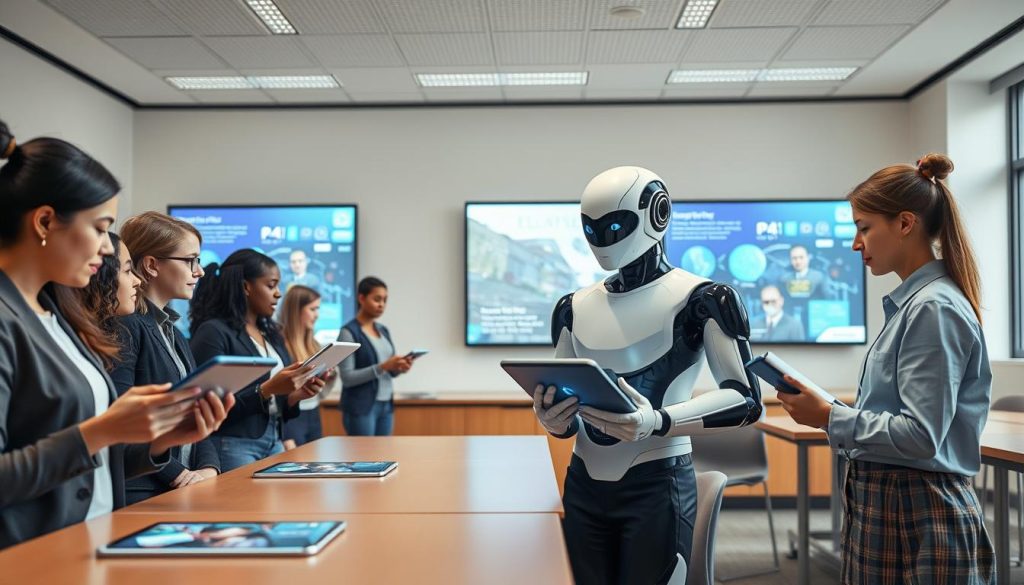
AI makes learning personal by looking at how students do. It then adjusts the material, speed, and methods to fit each student. This not only makes learning more fun but also helps students remember better and do well.
Personalized Learning Experiences
Thanks to AI, students can get lessons made just for them. AI looks at what they know, how fast they learn, and where they need help. Then, it makes a study plan that hits those spots. This helps students learn better in a way that’s just for them.
AI-Powered Tutoring Systems
AI tutoring systems show how AI is useful in schools. They give help and feedback in real time. These systems change as students’ needs change. They make sure every student gets help through their school journey. It’s like having a personal tutor for each student.
Putting AI in schools is shaping how we teach. It’s key for making schools ready for the future. As AI gets better, it promises a learning world that’s more suited to each student. It aims for an educational space that’s welcoming and fits everyone’s needs.
Security and Surveillance
The use of AI technology in homes has greatly improved security. Now, artificial intelligence is key for modern home surveillance. It not only makes us safer but also helps in smartly monitoring our homes.
Today, AI is critical in security for its ability to spot and study unusual behavior. This feature keeps homeowners informed and enhances their security efforts.
| Feature | Description | Benefits |
|---|---|---|
| Real-time Monitoring | AI systems analyze live footage from security cameras to detect unusual activities. | Enhances response times to security incidents, ensuring immediate action is taken. |
| Facial Recognition | Uses AI to identify individuals, distinguishing between residents and visitors. | Prevents unauthorized access, improving overall home security. |
| Behavior Analysis | AI algorithms learn normal behavior patterns and flag anomalies. | Reduces false alarms and focuses attention on genuine threats. |
Facial recognition tech, like Apple’s Face ID, shows how AI secures and meets homeowner needs. It’s key for checking identities and stopping unauthorized entry. This highlights AI’s vital role in protecting us and our properties.
In summary, everyday applications of artificial intelligence are transforming home security. They’re moving us towards more automatic, smarter homes where security and convenience are perfectly mixed.
AI Enhancing Marketing Strategies
In today’s competitive market, AI-powered devices are changing how companies plan their marketing. By using advanced technologies, businesses can target ads effectively and learn more from customer data.
Businesses use AI to improve how they interact with customers. By knowing what customers like, companies can make their ads more specific. This leads to more people paying attention and buying things.
AI technologies empower marketers to predict customer needs and provide personalized experiences that were not possible before.
AI tools analyze lots of data to find patterns. These patterns help marketers make smarter decisions. Marketers can then quickly change their plans based on what people want or new trends.
Targeted Advertising Techniques
AI makes ads more personal by using data about what users do and like. This way, companies can show ads that are more likely to be interesting to each person.
Customer Insights and Data Analysis
Data is key in marketing today, and AI is great at making sense of complicated data. The insights gained can guide new products, marketing plans, and better customer service.
- Segmentation and Targeting: AI finds different groups of customers by how they shop, making marketing more focused.
- Customer Journey Mapping: Marketers can better understand how customers interact with AI, improving the buying experience.
- Predictive Analytics: AI predicts what might happen next, helping marketers to be ahead of the game.
Adding AI to marketing makes things more efficient and meets what customers expect. This builds stronger relationships and loyalty. As AI grows, it will play an even bigger role in understanding data and making marketing more personal.

The Ethical Considerations of AI in Daily Life
AI technologies, like AI personal assistants, are becoming a big part of our lives. It’s important to think about ethical AI use to protect our freedoms and fairness. AI’s big role raises questions about privacy and fairness in how it works.
Privacy Concerns
AI’s growth in both private and public areas brings up privacy issues again. AI personal assistants need lots of personal data to work well. This is why it’s crucial to protect this data from being misused and to be clear about how it’s used.
Bias in AI Algorithms
Dealing with bias in AI systems is also a big ethical concern. If the data AI learns from is biased, its decisions can be unfair. So, companies need to work on finding and fixing these biases by using strong ethical AI practices.
Looking closely at these problems is key to creating a world where AI helps us without hurting ethical values. Let’s compare having rules for AI use against not having them:
| Aspect | Regulated AI Deployment | Unregulated AI Deployment |
|---|---|---|
| Data Privacy | High standards of data protection | Potential for data breaches |
| Algorithmic Transparency | Mandatory disclosure of AI decision-making processes | Lack of transparency in AI decisions |
| Bias Mitigation | Regular audits to check for and correct biases | Increased risk of perpetuating biases |
| Compliance with Ethical Standards | Adherence to ethical guidelines and practices | Possible ethical violations without accountability |
Using ethical AI frameworks makes AI technologies more trustworthy and helps them benefit society. It’s vital to balance innovation with ethics. This way, AI advances without stepping on our rights or creating more inequality.
Future Trends: AI in Our Lives
In the near future, AI will become a bigger part of our lives. It will change the way we do everyday things, making systems more complex yet helpful. AI will make tasks easier and improve our personal lives. This change will shake up how we live and interact with society.
The growth of AI will touch many areas, bringing big changes. It will make regular tasks easier and help solve tough problems. These improvements will make us smarter and life more convenient. They will blur the lines between technology, work, and play.
New AI innovations are on the horizon, full of promise. AI will get better at learning and adapting, changing many fields like health and education. This growth shows why we need to keep up and be open to changes. By doing so, we can make the most of AI’s benefits and tackle its challenges.
FAQ
How are home assistants and voice recognition AI used daily?
What are some examples of smart home devices and automation?
How does AI improve email communication?
What are AI-driven chatbots and how are they used?
In what ways does AI help with budgeting and expense tracking?
How is AI used in investment and stock market analysis?
What role do virtual health assistants play in healthcare?
How is AI utilized in diagnostics and treatment recommendations?
What are AI-powered project management tools?
How is automated data analysis changing the workplace?
How does AI contribute to navigation and traffic prediction?
What are the prospects for autonomous vehicles using AI?
How does AI curate personalized content recommendations?
What is AI-generated music and art?
What are personalized learning experiences in education?
How do AI-powered tutoring systems work?
How is AI integrated into home security systems?
What is facial recognition technology and how is it applied?
What are targeted advertising techniques that use AI?
How does AI assist with customer insights and data analysis?
What are the privacy concerns associated with AI?
How can bias in AI algorithms affect daily life?
What are the predictions for AI development in the near future?
What are the next big innovations in AI expected to be?
About the author : virtual-glasses