What Industries Use AI the Most?
Have you asked yourself which fields are leading the shift to an AI-dominated world? The change in business operations is clear. But, where does AI’s impact show the most? It goes beyond new tech. It’s about how AI’s practical uses and improvements shape key industries. This discussion reveals the sectors deeply integrating AI into their core processes.
Key Takeaways
- The healthcare sector leverages AI in diagnostics, patient care, and drug discovery, demonstrating profound impacts on personalized medicine and treatment innovation.
- Financial services utilize AI for enhanced fraud detection, algorithmic trading, and improving risk management compliance, showing AI’s critical role in securing and optimizing financial operations.
- In retail, AI creates personalized shopping experiences, streamlines inventory management, and powers customer service chatbots, highlighting AI’s versatility in enriching customer engagement and efficiency.
- Manufacturing industries integrate AI for predictive maintenance, robotics, and to streamline supply chain management, illustrating AI’s transformative capability in production environments.
- Transportation advancements through AI, such as autonomous vehicles and traffic management systems, emphasize AI’s potential in revolutionizing mobility and logistics.
- The use of AI in the energy sector with smart grids and renewable energy optimization showcases how AI can support the transition to sustainable energy solutions.
Introduction to AI in Industry
Artificial intelligence (AI) is changing industries all over the world. When we look at what industries use AI the most, we see that the business use of machine learning is key. It leads to better ideas and more efficient work in many areas.
Definition of Artificial Intelligence
Artificial Intelligence involves machines that act smartly, like humans, to do jobs. They also get better by learning from their data. This skill pushes industries to make smarter, data-driven choices.
Importance of AI in Modern Business
In today’s business world, AI is crucial for companies that want to be quick and strong during fast market shifts. AI improves operations, makes customers happier, and brings new innovations. It’s more than just a tool for doing things well. AI is key for long-lasting success and staying ahead.
| Industry | Application of AI | Impact on Business |
|---|---|---|
| Healthcare | Patient diagnostics and personalized treatment | Improves treatment accuracy and patient outcomes |
| Retail | Consumer behavior analysis and personalized shopping | Increases consumer satisfaction and sales |
| Manufacturing | Predictive maintenance and quality control | Reduces operational costs and enhances productivity |
| Banking | Fraud detection and risk management | Enhances security and compliance measures |
Healthcare Sector and AI
Artificial intelligence is changing healthcare in big ways. It helps doctors diagnose diseases better, manage patient care, and develop new drugs faster. This shift is making treatments more effective and precise.

AI in Diagnostics
AI is now able to spot diseases from images better than some doctors. For example, Google’s AI can detect breast cancer with 94.5% accuracy. This is faster and more precise than specialists. It means diseases can be caught earlier and treatment can start sooner.
Patient Care and Personalization
AI is also making patient care more personal. It analyzes lots of patient data to figure out how someone might react to a treatment. This helps doctors create treatment plans that are just right for each person’s DNA.
Companies like Tempus are leading this work. They use AI to look at data from clinical trials and genetic tests. This helps them find the best treatment plans for cancer patients, improving their chances and lowering side effects.
Drug Discovery and Development
In the world of medicine, AI is speeding up the creation of new drugs. It tests how molecules interact and can pick out good drug candidates quickly. This means new medicines can be made faster, helping us deal with health crises sooner.
Financial Services Utilizing AI
Artificial intelligence is changing how financial services work with data and interact with customers. It’s making fraud detection better and trade and compliance smarter. Basically, financial services are becoming more efficient and safer thanks to AI.
Fraud Detection and Prevention
Big names like Mastercard and Bank of America use AI to watch transactions closely. This stops fraud as it happens. AI tools spot unusual activity quickly, protecting customer money and increasing their trust.
Algorithmic Trading
In algorithmic trading, AI is a game-changer. Firms like JPMorgan Chase use AI to look at market trends and what customers do. This improves their decisions and helps manage risks better.
Risk Management and Compliance
Financial companies use AI to handle lots of data. This helps with following rules and figuring out risks. JPMorgan is a leader in using AI for reviewing legal contracts. This shows how AI can manage complex rules and lower credit risks.
Retail Industry Embracing AI
Artificial Intelligence is changing the retail world. It improves customer experiences and how businesses manage inventory. The use of AI in retail is creating efficient and happier shopping experiences for customers.
Personalized Shopping Experiences are key in today’s retail game, thanks to AI. Companies like Amazon are making shopping personal. Its engine that suggests products is a big reason 35% of its sales happen.
- AI looks at what you’ve bought before to recommend new items.
- It also adjusts prices in real-time, reacting to the market.
Inventory Management is another area that’s been upgraded with AI. Big players like Walmart have shown how it’s done. They use AI to keep stock levels just right, avoiding too much or too little, which saves money and makes the supply chain better.
- AI predicts what will be needed, adjusting stock early.
- It also helps auto-restock, cutting down on mistakes and delays.
Customer Service Chatbots are now essential in retail, thanks to AI. Take Bank of America’s Erica as an example. It shows how AI can help talk to customers anytime, answering quickly and correctly. This makes customer service better.
- Chatbots take care of the simple questions, letting humans handle the tough ones.
- They work with CRM systems for a more personalized chat.

Manufacturing and AI Integration
AI is changing the manufacturing industry in big ways. It helps make production better and supply chains smarter. Manufacturers around the world are seeing big improvements in how they work and manage risks by using AI.
Predictive Maintenance greatly benefits from AI in manufacturing. With AI, companies can know when machines might break before it happens. This helps reduce downtime and make machines last longer. GE is one company that uses AI to better plan their maintenance, saving money and increasing safety.
Robotics and Automation are at the heart of AI in manufacturing. AI robots do more than simple tasks. They can now handle complex jobs needing learning and decision-making. Siemens uses smart robots to do difficult production tasks, increasing productivity and making workplaces safer.
Supply Chain Optimization shows how valuable AI is in manufacturing, seen in companies like DHL. AI helps make everything from planning to delivery smoother and more accurate. It helps in predicting needs, planning based on those predictions, and making quick decisions, which boosts efficiency all through the supply chain.
| AI Functionality | Implementation Example | Impact on Manufacturing |
|---|---|---|
| Predictive Maintenance | GE’s Service Schedules | Reduces downtime, prolongs equipment lifespan |
| Robotics and Automation | Siemens’s Robotics Systems | Enhances production efficiency, improves safety |
| Supply Chain Optimization | DHL’s Logistics Operations | Streamlines production, improves delivery accuracy |
Today, being fast, reliable, and efficient is key to staying ahead. AI doesn’t just make manufacturing smoother. It also ensures operations can grow and last even as markets keep changing.
Transportation and AI Advancements
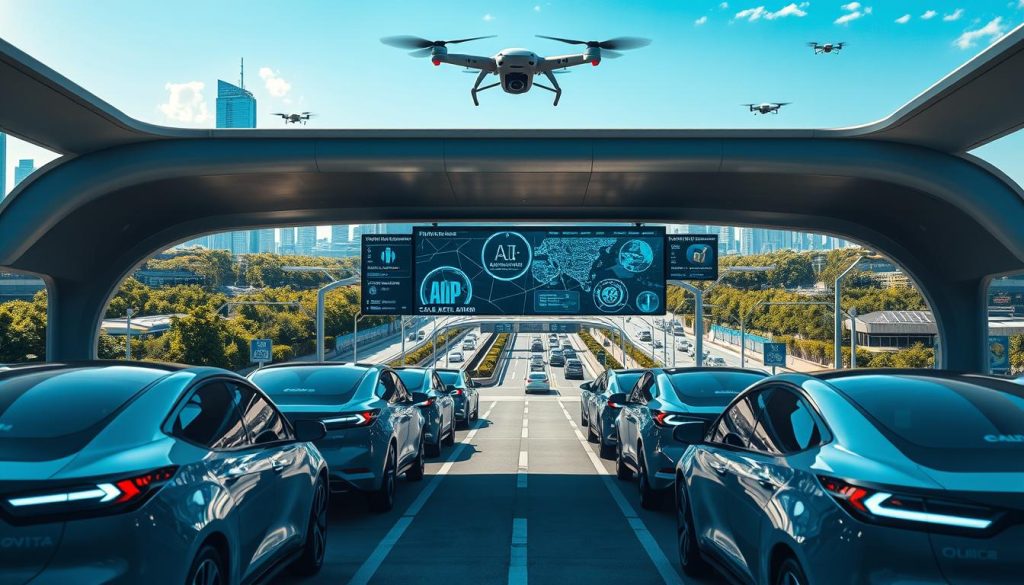
AI technology in transportation is changing how we look at getting around. It touches everything from driverless cars to smarter traffic systems. We’ll explore areas where AI makes travel safer and more efficient.
Autonomous Vehicles
Driverless cars are at the heart of these changes. They use AI to make safe paths through traffic. This not only aims to cut down accidents but also eases traffic jams and quickens trips.
Traffic Management Systems
AI is transforming how traffic is managed. It uses tons of data, like satellite photos and street sensors, to smooth out traffic flow. Tools like Google Maps take this data to suggest the best routes, helping trucks and buses run on time.
Route Optimization
AI also makes finding the best way to get somewhere easier, especially for delivery and public transit. It looks at traffic, weather, and how vehicles are running. This way, it finds routes that save time and money.
| Technology | Application | Benefits |
|---|---|---|
| Autonomous Vehicles | Navigation and safety | Improves safety, reduces congestion |
| Traffic Management Systems | Traffic flow optimization | Enhances road safety, minimizes congestion |
| Route Optimization | Logistics & delivery optimization | Reduces delay, cuts operational costs |
The journey of AI in transportation is still unfolding. As it does, our roads and routes could get much smarter. This isn’t just a leap in tech. It’s a step toward greener, cleaner cities where getting around is a breeze.
Agriculture’s Adoption of AI
In exploring what industries use AI the most, agriculture is a top user. It quickly adopts advanced tech. As the need for food grows worldwide, AI in agriculture is key for keeping things sustainable and efficient.
Precision Farming Techniques
AI-driven precision farming is changing how farmers work with their land. It uses data analytics for a close look at soil and crops. This leads to better use of resources and higher yields, making farming more scientific.
Crop Monitoring
AI lets farmers keep a close eye on their crops at all times. It uses info from drones and sensors to track crop health. This way, farmers can act fast to protect their crops from harm.
Predicting Weather Patterns
Knowing what the weather will do is another big help from AI in farming. AI-based weather forecasts let farmers plan better and reduce risks. This is crucial for dealing with bad weather.
By using AI, farming is becoming more flexible and tough. This is important for feeding the future in a smart and lasting way.
Education Sector Implementing AI
Tech companies are bringing AI into the education world, making big changes for students and schools. With AI, learning becomes more tailored, effective, and open to everyone. Here’s a look at the major ways this technology is making a difference.

Personalized Learning Environments
Platforms like Duolingo use AI to create learning that fits each student. This approach keeps students interested and helps them learn better by giving them just-right challenges. By understanding how students learn, AI helps make school tools even better.
Administrative Efficiency
AI isn’t just for classrooms. Georgia State University uses an AI chatbot to make admin work smoother. This chatbot helps prevent students from dropping out by quickly giving them the info they need. AI shows big promise in making school operations more focused on students and running smoothly.
AI-Assisted Tutoring
AI is also changing tutoring by giving personalized help to each student. It adjusts to how fast or slow a student learns, finds where they need help, and gives practice to improve those areas. Students get the right kind of support to tackle their challenges and do well in school.
Telecommunications and AI
Telecommunications is a key sector where AI’s influence is highly questioned. AI is crucial for making networks stronger. It enhances customer experiences and reduces service problems by using predictive maintenance. This marks a big change towards better and more personalized telecom systems.
In network optimization, AI helps analyze and efficiently manage data traffic. This ensures networks can handle more data without losing speed or quality. So, services stay reliable without interruption.
AI greatly improves customer service. It uses analytics and learning algorithms to offer personalized interactions and proactive solutions. These advances increase satisfaction and simplify resolving service issues, making them both effective and user-friendly. For more on AI’s role in bettering telecom user experiences, click this link.
Predictive maintenance is crucial for telecom service reliability. AI can foresee network problems before they happen, leading to timely fixes that prevent downtime. This capability is key for keeping telecom networks running smoothly, showing a big jump in how well they operate.
The use of AI shows that telecommunications is a leading area in AI application. As AI grows, it will keep pioneering new methods to manage networks, boost customer service, and ensure systems run without fail.
Energy Sector Utilizing AI Solutions
The energy sector’s ongoing use of AI shows why asking what industries use AI the most matters. AI-driven tech is greatly improving efficiency, safety, and sustainability. This proves AI’s crucial role in changing the energy scene.
Smart Grids: AI in smart grids is changing how we distribute energy. These AI systems manage energy flow, add renewable sources to the grid, and adjust to energy demands in real-time. Thanks to this tech, we get a more reliable energy supply and waste less by using real-time data to adjust energy distribution.
Predictive Asset Management: AI also helps in predictive maintenance within the energy sector. By analyzing sensor data on equipment, AI predicts possible breakdowns before they happen. This approach lessens unexpected downtime and keeps expensive equipment running longer, cutting costs.
Renewable Energy Optimization: AI plays a big role in making renewable energy like solar and wind more efficient. AI analyzes weather data to predict sunlight and wind patterns. This helps energy firms boost renewable energy output, making it more reliable and easier to include in the power grid.
These improvements show the energy sector’s key role in using AI, a trend that’s likely to keep growing as the need for innovative and sustainable energy solutions increases. Exploring AI in energy not only helps with efficiency but also aids in achieving environmental sustainability goals. This highlights AI’s importance in shaping the future of global industries.
Marketing and Advertising with AI
Artificial Intelligence (AI) is making a big splash in marketing and advertising. This is a key area among what industries use AI the most. AI brings things like super-personal ads and deep looks into what customers want. It changes old-school marketing into smart, data-driven plans.
Targeted Advertising: AI digs through huge amounts of data to really get consumer tastes. This way, businesses can make ads that hit the mark better. This leads to more sales.
Consumer Behavior Analysis: AI is great at seeing patterns in what people buy and do. It gives companies the info needed to make their marketing hit the right notes, focusing on specific people.
Content Generation: AI is also changing the game in making content for marketing. Tools that create texts, images, and videos help brands keep things fresh and interesting. This keeps customers coming back for more.
| Feature | Benefits | Applications |
|---|---|---|
| Targeted Advertising | Higher relevance, Increased engagement, Improved conversion rates | Digital ads, Social media platforms, Email marketing campaigns |
| Consumer Behavior Analysis | Deeper consumer insights, Enhanced personalization, Strategic decision making | Market research, Customer relationship management, Product development |
| Content Generation | Scalability, Cost-efficiency, Consistency in brand voice | Blog posts, Social media content, Advertising copy |
Conclusion: The Future of AI in Various Industries
AI’s growth is changing many sectors quickly. Industries everywhere are asking: What fields involve AI the most? This question gets harder as more areas see AI’s big impact. In healthcare, AI is making patient care better. In finance, it’s used for stronger security and smoother operations.
Retail and manufacturing are improving the way they serve customers and make products. Agriculture, telecommunication, energy, education, transportation, and marketing are all using AI too. They’re tapping into AI’s power to do things better and smarter.
Emerging Trends in AI Technology
Industries are watching new AI models and innovations closely. They’re excited about things like federated learning. This lets machines learn from data that’s spread out, all without risking privacy. AI is also getting better at understanding human language and seeing like we do. This is great news for agriculture and retail.
They’re ready to change how they operate, using AI. The growth of AI suggests big changes in how we work. It’s leading to better strategies and productivity that we haven’t seen before.
Final Thoughts on AI Integration Across Sectors
As AI finds its place in different industries, its potential for new solutions grows clearer. With each sector that incorporates AI, the landscape changes. This reflects how broad AI’s reach is. Investing in AI means moving towards a modern, productive future. It’s not just about keeping up with trends.
Companies using AI are setting new standards. They’re improving customer experiences and gaining an edge that lasts. This advantage is built on the solid ground of tech progress.
FAQ
What industries use AI the most?
What is the definition of Artificial Intelligence?
Why is AI important in modern business?
How is AI used in diagnostics?
How does AI contribute to patient care and personalization?
What role does AI play in drug discovery and development?
How is AI used in fraud detection and prevention in financial services?
What is algorithmic trading and how does AI impact it?
How does AI assist in risk management and compliance?
How does the retail industry use AI to create personalized shopping experiences?
What is the role of AI in inventory management?
How are customer service chatbots used in retail?
What is predictive maintenance in manufacturing?
How are robotics and automation enhanced by AI in manufacturing?
How does AI optimize supply chain management?
How is AI technology revolutionizing transportation?
What role does AI play in traffic management?
How does AI help in optimizing delivery and transportation routes?
What are precision farming techniques in agriculture?
How is crop monitoring improved through AI?
How does AI aid in predicting weather patterns for agriculture?
What is the impact of personalized learning environments in education?
How does AI increase administrative efficiency in education?
What is AI-assisted tutoring and how does it benefit the education sector?
How is AI used for network optimization in telecommunications?
What advancements has AI brought to enhancing customer experience in telecommunications?
How does AI contribute to predictive maintenance in telecommunications?
What is the purpose of smart grids in the energy sector?
How does AI facilitate predictive asset management in energy?
How is AI used in optimizing renewable energy sources?
How does AI play a role in targeted advertising?
How does AI analyze consumer behavior?
What is content generation in AI and how is it used in marketing?
What are the emerging trends in AI technology?
What are some final thoughts on AI integration across sectors?
About the author : virtual-glasses