Unlocking the Secrets of AI Learning from Data
How can a chess engine beat grandmasters, or a social network find the perfect video for you? These wonders show a big question: How does AI learn from data? This asks us to look into how AI turns simple data into amazing things we use every day. People like Kristin Lauter are leading this work. They make AI better and keep our online world safe and private.
In this data-filled age, AI does more than just act smart. It does things like predict text with ChatGPT or help doctors find diseases early by understanding data. Lauter is really good at using AI to keep things secret online. Her work, and studies like SALSA, show how AI is both a creative tool and a shield against online dangers.
Key Takeaways
- AI has evolved to perform complex tasks smoothly, showcasing its inherent potential in practical applications.
- Data is the lifeblood of AI, serving as the foundation upon which machine learning models are built and refined.
- AI machine learning can be implemented for enhancing online privacy through cryptography, as demonstrated by Kristin Lauter’s research.
- The development of strategies like SALSA highlights the importance of AI in testing and improving cybersecurity protocols.
- Understanding how AI learns from intricately large datasets allows us to appreciate and responsibly harness its transformative power.
Understanding the Basics of AI Learning
Artificial intelligence (AI) leads tech advances, making industries smarter with data and automation. AI mirrors human thought by learning, making rules, and fixing mistakes. It gets better by learning from data, thanks to machine learning algorithms.
What is Artificial Intelligence?
AI copies human skills, ranging from robots to smart software. It learns like our brains do, using complex algorithms. These help in everything from understanding speech to predicting stock trends.
The Role of Data in AI
Data is crucial for AI’s success. Good data helps AI learn effectively. It works by analyzing big data sets, finding patterns, and making smart choices. Neural networks keep improving by learning from new data.
A comparison of old-school programming and AI learning shows:
| Aspect | Traditional Programming | AI Neural Network Training |
|---|---|---|
| Based on | Explicit Instructions | Collected Data |
| Learning Capability | None | Continuously Evolving |
| Decision Making | Static Logic Patterns | Dynamic, Data-Driven Algorithms |
This table highlights the shift from basic programming to AI-driven methods. AI uses learning algorithms that adapt and grow, opening new possibilities in various fields.
Types of Machine Learning
Machine learning is a key part of artificial intelligence. It helps create models that can learn and make decisions from data. There are many types, including supervised, unsupervised, and reinforcement learning. Each uses data mining techniques and deep learning models for smart predictions.
Supervised Learning
Supervised learning is widely used in machine learning. It uses labeled data to teach algorithms to predict outcomes. This method is important in many fields. For example, in healthcare for disease diagnosis and in finance for spotting fraud.
Unsupervised Learning
Unlike supervised learning, unsupervised learning doesn’t use labeled data. It looks for hidden patterns in the data. This is crucial in marketing. It helps understand customer groups and their preferences by analyzing data.
Reinforcement Learning
Reinforcement learning focuses on making decisions. It aims to reach a goal in an uncertain setting. The systems improve decision-making by learning from past actions. This is changing fields like robotics and self-driving cars, thanks to data mining techniques and deep learning models.
The Data Pipeline in AI
Creating a strong data pipeline is vital for AI learning strategies. This journey includes steps like collecting, curating, preprocessing, and cleaning data.
Gathering and curating data is key for machine learning. It means pulling data from many places and making sure it’s good and fits the project. This step fixes errors and removes useless info, making the dataset perfect for the AI’s needs.
The next step is data preprocessing. It involves getting rid of wrong and repeated data, making all data fit a set range, and preparing it for the machine learning model. Cleaning the data makes sure only accurate info goes into the machine learning algorithms. This prevents mistakes in the AI’s results.
Every step in the data pipeline is essential for AI to work well. Without a good data pipeline, machine learning might not be effective, leading to unreliable results. So, a strong data management system is crucial for precise AI outcomes.
Feature Selection and Engineering
In the world of Artificial intelligence data analysis and machine learning algorithms, choosing the right features is key. It makes AI models more predictive. This is why feature selection and engineering are so critical in developing smart AI systems.
Importance of Feature Engineering
Feature engineering transforms raw data into a better format for models. This step boosts their performance a lot. By adding new features to the dataset, developers give models deeper insights. This leads to more accurate predictions.
Techniques for Feature Selection
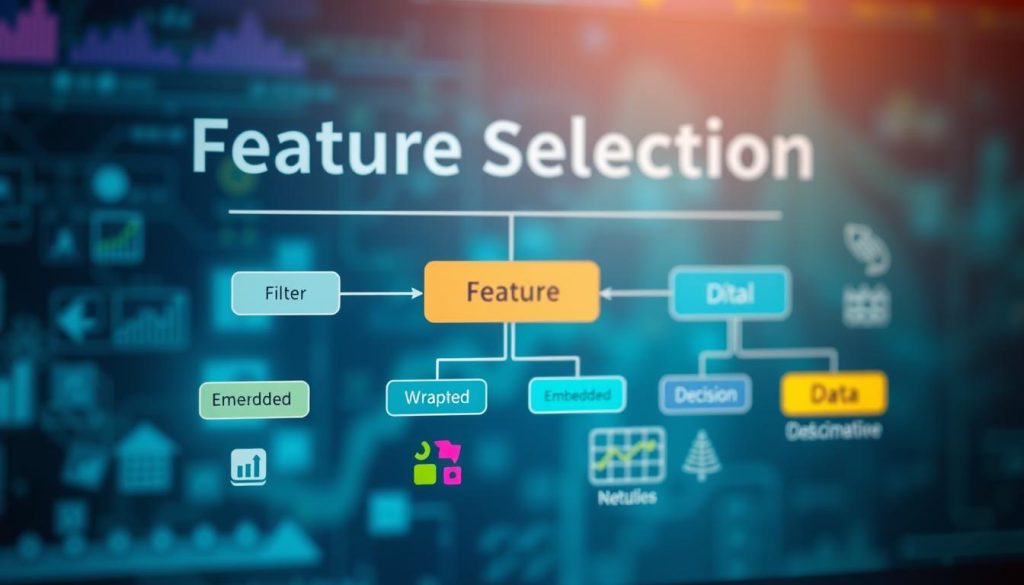
Feature selection techniques also help improve model performance. They aim to cut excess, boost accuracy, and lessen computational needs. This is done by removing features that are not needed.
| Technique | Description | Benefits |
|---|---|---|
| Filter Methods | Apply a statistical measure to assign a scoring to each feature so you can choose which features to keep based on their scores. | Efficient in computational terms, independent of machine learning model. |
| Wrapper Methods | Use a subset of features and train a model using them. Based on the inferences that can be drawn from the model, decide whether to add or remove features from your model. | Effective in finding the best subset of features although computationally expensive. |
| Embedded Methods | These methods perform feature selection during the model training process and are typically specific to given learning algorithms. | Leverages the power of machine learning algorithms to select features and are faster than wrapper methods. |
Algorithms Used in AI Learning
In the growing world of artificial intelligence, choosing the right algorithms is key. The decision impacts how effective Data-driven AI solutions are. Knowing about supervised and unsupervised algorithms helps to build a strong foundation in AI development.
Supervised learning, with methods like linear regression and decision trees, is crucial. It uses known data to train the Neural network training process for predicting results. On the flip side, unsupervised learning algorithms, such as K-Means clustering, do not need labeled data. They find patterns or structures in the data by themselves.
Popular Algorithms Overview
- Linear Regression – Used extensively for prediction in numerical data sets.
- Decision Trees – Offers clear visual representation of decisions and their possible consequences.
- K-Means Clustering – Ideal for market segmentation, image compression, and more.
Comparing Supervised and Unsupervised Algorithms
There’s a big difference between supervised and unsupervised learning. Supervised learning needs labeled data and is great when past data predicts the future. Unsupervised learning doesn’t need labels. It’s good for finding how data is structured, especially when it’s not clear what the data represents.
Training an AI Model
Training deep learning models starts with setting up a strong neural network. We tweak the model and its learning space to get the best results. It’s all about making them perform better and more accurately.
The training process is key. It goes through several steps where the AI gets better using datasets. It begins with setting up weights and biases. Then, we adjust them based on what we learn from the training data.
Tweaking hyperparameters is a fine art that boosts training effectiveness. We carefully adjust things like learning rate, batch size, and how many times we go through the data. This makes the model learn better and faster. It helps the model work well in the real world, not just in training. Choosing the right hyperparameters lets us train models faster, so they’re ready to use sooner.

Hyperparameter tuning plays a big part in training neural networks. Consider this table to see its impact:
| Hyperparameter | Description | Impact on Training |
|---|---|---|
| Learning Rate | Controls how much to update the model in response to the estimated error each time the model weights are updated. | Crucial for convergence speed and stability. |
| Batch Size | Number of training samples used in one iteration. | Influences the model’s generalization and training speed. |
| Epochs | One Epoch is when an ENTIRE dataset is passed forward and backward through the neural network only ONCE. | Determines how many times the learning algorithm will work through the entire training dataset. |
This careful tuning is crucial for fitting deep learning models to specific tasks. It makes them perform better and adjust to new challenges.
Evaluation Metrics for AI Models
Checking how well AI models work is key to knowing if they’re good for real-life uses. We look at different ways to measure their effectiveness, emphasizing the need for careful checking.
It’s key to see how machine learning algorithms do in various situations. This helps make AI better. By looking at things like how accurate or precise they are, developers learn what’s great or not about their models.
- Accuracy: Looks at how often predictions are right.
- Precision: Checks how many of the positive guesses were correct.
- Recall: Sees if the model can find all the important cases.
- F1 Score: Combines precision and recall into one measure.
For AI machine learning to be strong, testing them well is a must. When we test them with new data, we make sure they’re really learning. This also spots biases and mistakes not seen early on.
In the end, using many measures to test is key for trustworthy AI models. Doing this well is critical for making the most of AI machine learning in all fields.
Overfitting and Underfitting
In AI learning and deep learning, we often face overfitting and underfitting challenges. Overfitting happens when a model learns too much from its training data, including errors and oddities. This makes it bad at handling new data. Underfitting is when a model is too simple and misses the complexity of the data. This leads to poor results on both known and new data.
There are ways to find the right balance in AI learning.
Understanding Overfitting:
Imagine a student who memorizes facts but can’t apply them in real life. That’s like overfitting in AI. The model does great with its training data but fails with new data. Deep learning models, due to their complexity, often fall into this trap.

To avoid underfitting, matching the model’s complexity with the task is crucial. Using cross-validation helps. It checks the model with different data parts. Regularization, which penalizes complexity, is also key. Another method is ensembling, where combining models enhances performance.
The aim is to balance sophistication and simplicity in models. This ensures they learn important patterns without getting overwhelmed by the data’s noise. By applying these strategies, deep learning’s performance improves across different fields.
The Role of Neural Networks
Neural networks are at the heart of leading artificial intelligence systems today. They imitate the human brain’s complexity to learn from huge data amounts. Through the neural network training process, they play a key role in using AI in many fields. This shows how vital they are in pushing technological boundaries forward.
Neural networks have layers with connected nodes, or neurons. These nodes can learn to spot data patterns. This learning ability lets AI do tasks like translating languages or recognizing faces.
The neural network training process involves changing the network’s connections. This change, called backpropagation, helps the network learn from training data. It fine-tunes its responses, getting better at making predictions or decisions.
Deep learning uses complex neural networks to understand data more deeply. It lets machines think and learn like humans, such as understanding complicated data or learning from the past.
These technologies have huge effects on different industries. In healthcare, they diagnose diseases with high accuracy. In the auto industry, they are improving self-driving cars. The power of the neural network training process is making big advances in AI possible. It’s a foundational part of AI research and development today.
Challenges in AI Learning from Data
The AI machine learning journey faces big challenges that greatly impact data-driven AI applications. It’s crucial to tackle these issues to fully tap into AI’s potential.
The quality of data used is a big obstacle in AI machine learning. Problems with data can come from mistakes in collecting it, not processing it well, or not checking it continuously. Bad data hurts AI model performance and limits useful insights.
Data Quality Issues
The saying “garbage in, garbage out” is especially true in AI machine learning. You need top-quality data to train models well. Missing values, inconsistent formats, and noisy data can mess up training, leading to unreliable AI outcomes. It’s key to handle data carefully from the start to the end.
Bias in Data
Data bias is a big challenge, too. It can make AI systems biased. This is a huge problem in areas like predictive policing and hiring, where bias can worsen societal issues. To fight data bias, picking data sources carefully, balancing datasets, and applying fairness measures in AI are needed.
| Challenge | Impact | Mitigation Strategy |
|---|---|---|
| Poor Data Quality | Lower accuracy and efficiency of AI models. | Implement rigorous data cleaning and validation protocols. |
| Data Bias | Potential perpetuation of existing societal biases. | Utilize de-biasing techniques and diverse data sources. |
To move AI machine learning forward, we must understand and tackle these challenges. By dealing with these issues, developers can make AI systems more reliable, fair, and effective for various uses.
Real-World Applications of AI Models
Artificial intelligence (AI) and machine learning are changing how different sectors operate. They are key in reaching new heights in industries like healthcare and financial services. Let’s take a look at how AI is used to innovate and increase efficiency in these important fields.
Healthcare Innovations:
- AI is great at finding diseases like skin cancer and heart disease quickly and accurately.
- It also helps create custom treatment plans by looking at patient data. This means more effective care for everyone.
Financial Services Optimization:
- AI helps in making predictions which lets financial organizations make smarter investment choices and offer better advice to clients.
- Machine learning is crucial for detecting fraud. It makes transactions safer and protects clients’ money.
The Future of AI Learning
AI technology is moving fast, changing how we think about learning and data. It’s focusing on making deep learning and data mining better. These steps are shaping a future where machines learn and adapt in amazing ways. Also, AI is now moving into new fields, promising big changes in many industries.
Emerging Trends in AI
Many new trends are shaping AI learning. One of these is generative AI models, which are great for creativity and innovation. AI is also stepping into areas like environmental science and manufacturing. There, it helps predict weather changes and prevent expensive delays. Deep learning models are improving how we recognize images and voices, changing how we interact with machines.
The Impact of Quantum Computing on AI
Quantum computing and AI together are really exciting. Quantum computing could change how fast we can process data. It can do lots of calculations at once, which could make AI much more powerful. This means AI could solve hard problems faster, leading to big breakthroughs in science.
FAQ
What is Artificial Intelligence?
What is the role of data in AI?
What is supervised learning?
What is unsupervised learning?
What is reinforcement learning?
What does data collection and curation entail in the AI data pipeline?
Why is data preprocessing and cleaning important?
Why is feature engineering important?
What techniques are used for feature selection?
What is the difference between supervised and unsupervised learning algorithms?
How does the training process for an AI model work?
Why is hyperparameter tuning necessary?
How are AI models evaluated, and why is it important?
What is overfitting, and how can it be prevented?
What are the basics of neural networks?
How does deep learning differ from traditional machine learning?
What challenges arise from AI learning from poor-quality data?
How can bias in data affect AI learning?
How are AI models transforming healthcare?
In what ways are AI models optimizing financial services?
What are the emerging trends in AI?
How might quantum computing impact AI?
About the author : virtual-glasses