
Will AI Surpass Human Intelligence?
Is AI going to outsmart human brains? Key figures like Sam Altman believe AI is growing quickly, making huge strides. This jump forward is causing a big buzz. People are debating if AI could reach or even pass human smarts. As AI gets better at tasks, like beating humans in games or doing surgeries with great accuracy, we wonder what’s next for the future.
Experts think machines could think like us sooner than we believe. Some say there’s a 50% chance in the next 40 years, others see a 10% chance in less than a decade. This shift in thinking about intelligence is huge. Machines are getting closer to what we thought only humans could do. The fear of AI growing too fast and out of control worries many. It brings up the scary idea of superintelligent AI that Stephen Hawking warned us about.
This mix of breakthroughs and deep thoughts keeps the big question alive. It makes us rethink what we know and sparks our curiosity. Could we be headed to a time when machines are viewed as the smartest beings?
Key Takeaways
- Sam Altman and other key thinkers say AI might outdo human intelligence soon.
- There’s a good chance AI will think like us in the next few decades.
- AI is now good at complex games, surgeries, and driving cars on its own.
- The idea of AI growing too fast brings up serious risks and ethical issues.
- Famous minds like Stephen Hawking have raised alarms on the dangers of super smart AI.
Understanding Artificial Intelligence and Its Evolution
The growth of artificial intelligence (AI) is a story filled with amazing breakthroughs and big ideas. Understanding this journey shows us not only big leaps in technology but also how thoughts of machine consciousness and computational intelligence have evolved. This helps us imagine what AI might be able to do later on.
Brief History of AI Development
The tale of AI starts with smart people like Alan Turing. He thought machines could act like humans one day. This big idea helped create AI as we see it today. In the 1950s, the idea of artificial general intelligence came up. It encouraged researchers to dream big about smart machines.
Key Milestones in AI Technology
Looking at the big moments in AI helps us see how fast it’s moving. A standout moment was when IBM’s Deep Blue beat chess champion Garry Kasparov in 1997. This wasn’t just about being fast at calculations. It showed that AI could think through strategies and adapt, key parts of machine consciousness.
Also, the idea of a “singularity” has been discussed for a while. It’s when AI might think better than humans. This talk and work in AI show how tech and ideas grow together. They lead us to a future where AI could change everything smoothly and in big ways.
Defining Human Intelligence
Human intelligence is a mix of many features. It includes thinking skills, feeling deeply, and the way we connect with others. These aspects help us understand and face the world’s challenges. Unlike machines or AI, humans can use emotions and context to make genuine connections. This part of intelligence is key in our daily choices and interactions.
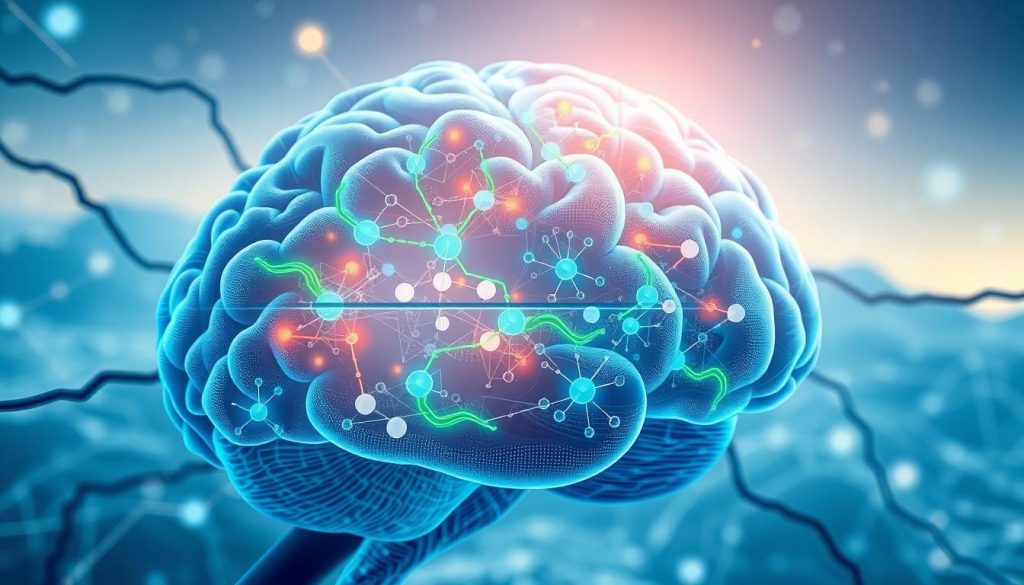
When we look closer at human cognition, we see it’s different from AI and cognitive computing. Children, for instance, adapt and learn quickly—a benchmark AI aims for. This ability to learn quickly and use new ideas in many ways is a goal for cognitive computing.
Also, emotional and social intelligence are central to human understanding, but AI often misses these. The capacity to empathize is uniquely human. Even the most advanced AI can’t fully grasp the depth of human emotions and how they affect our relationships and decisions.
| Feature | Human Intelligence | Human-level AI & Cognitive Computing |
|---|---|---|
| Learning Flexibility | Adapt instantly to new information | Requires extensive data and retraining |
| Contextual Understanding | Draws from a rich context of experiences | Primarily relies on programmed data sets |
| Emotional Depth | Empathy and emotional nuance inherent to interactions | Lacks genuine emotional response, mimics based on algorithms |
AI is improving, but it hasn’t matched the full range of human intelligence yet. Especially in understanding emotions and social cues, AI still has a long way to go.
Current Capabilities of AI
AI is growing fast, changing many areas with better machine learning and deep learning. Exploring technological superintelligence and machine consciousness shows AI’s great skill in handling human language. Thanks to natural language processing, its understanding has hit new heights.
Machine Learning and Deep Learning
Machine learning algorithms and deep learning networks have hugely boosted AI’s abilities. They let AI systems learn from lots of data. This means they can make choices and get better on their own. AI can now do complex tasks and is sparking new ideas and efficiency in many fields.
Natural Language Processing Advances
Natural language processing (NLP) is a big leap forward for AI, helping it talk better with us. This tech makes AI get, use, and create human language in ways that make sense. NLP keeps getting better, moving us towards machine consciousness. It might soon allow machines to get and show human feelings.
- Deep learning applications in image and speech recognition
- Enhancements in AI-driven predictive analytics
- Advancements in autonomous vehicles and robotics driven by machine learning
AI vs. Human Intelligence: A Comparative Analysis
Exploring cognitive computing reveals a deep comparison between AI and human thought. Computational intelligence has grown fast, especially in areas where AI outperforms human skills.
| Aspect | AI Performance | Human Performance |
|---|---|---|
| Strategy Games (e.g., Chess, Go) | Superior due to algorithmic precision and vast data processing | Limited by cognitive and memory capacity |
| Data Analysis | Handles large datasets efficiently with high accuracy | Analysis constrained by slower biological processing speeds |
| Creative Arts | Can replicate styles but lacks originality | Excels in original creation and emotional depth |

AI evolution shows progress, but creativity and emotional understanding are still lacking. Unlike humans, AI mainly copies and spots patterns, showing a clear limit.
Knowing where AI shines and falls short is key. It helps us blend AI into society wisely, taking advantage of its benefits while covering its flaws. This knowledge matters as we keep improving in cognitive computing and computational intelligence.
Ethical Implications of AI Advancements
AI is advancing quickly, bringing up complex ethical issues. We’re now facing the challenge of integrating AI ethics and machine consciousness. This tests our usual ideas of how machines make decisions and understand right from wrong.
People worry about AI’s decision-making, especially when it affects humans directly. In areas like healthcare and law enforcement, decisions by AI can change lives. This brings up concerns about bias, privacy, and who is responsible.
Concerns Over AI Decision-Making
AI is now making important decisions in places traditionally handled by humans. The key challenge is to create AI with strong ethical principles. This means making AI’s decision process clear and understandable, which is vital for trust between humans and machines.
The Morality of Autonomous Systems
The development of superintelligent AI raises big questions. These include issues about whether machines can have consciousness or moral responsibility. Autonomous systems are being designed for tasks that need not just skill but also an understanding of ethics.
The ethical debate about AI isn’t just about avoiding harm or being fair. It’s also about how AI can uphold and improve human values. As AI plays a bigger role in our lives, following ethical guidelines and making sure regulation keeps up will be crucial.
The Role of AI in Enhancing Human Abilities
The growth of AI evolution has made it a powerful tool to help people do better in many areas. Cognitive computing and artificial general intelligence make things more efficient and improve work quality in many jobs.
In healthcare, AI helps diagnose diseases more accurately, pushing us towards tailored medical treatments. In finance, AI helps analysts by predicting stock trends from market data. This helps them make smarter choices. And in education, AI creates learning plans that match what each student needs, helping them learn better.
The entertainment world has also changed because of AI. It suggests things to watch based on what you like. The mix of AI evolution, cognitive computing, and artificial general intelligence has truly changed many fields. It has made a big difference in how well we can do our work.
| Industry | AI Application | Impact |
|---|---|---|
| Healthcare | Diagnostic algorithms | Enhanced accuracy in disease diagnosis |
| Finance | Risk assessment tools | Improved decision-making |
| Education | Customized learning modules | Personalized learning experiences |
| Entertainment | Content recommendation engines | Customized consumer experiences |
The use of AI as a way to improve human skills shows how much artificial general intelligence can do. It helps us imagine a future where AI and human effort combine to achieve amazing things.
Predictions for the Future of AI Development
Experts predict exciting times ahead in artificial intelligence (AI). People like Sam Altman and Ray Kurzweil make bold forecasts. They talk about human-level AI and singularity technology coming in our lifetime. Experts think that by 2040, AI could reach a pivotal moment, creating excitement and concern among scientists.
The path of AI is moving towards what is known as superintelligent AI. This kind of AI might do things better than humans. Such changes could drastically alter our world, leading to great advancements that could both disrupt and benefit society. We’re looking into expert views and the big changes that could come in the next decades.
“We are approaching an era where the capability of brain-inspired superintelligent AI could outpace human ability.”
With AI’s growth, we face ethical challenges. It brings up important discussions about how we use this powerful technology responsibly. Balancing great power with ethical use highlights the good and bad sides of the future.
Expert Opinions on AI Progress
Top minds in tech and ethics share their thoughts on AI’s evolution. They offer a wide range of possibilities, from AI improving daily life to careful management of its power.
Potential Breakthroughs in the Coming Decades
There are many exciting AI developments expected. The table below shows what industry leaders think will happen soon.
| Breakthrough | Estimated Timeframe | Potential Impact |
|---|---|---|
| General AI reaching human-level intelligence | 2040-2050 | Could result in significant shifts in all sectors including healthcare, education, and transportation. |
| Implementation of ethical AI governance | 2025-2030 | Establishment of global standards for AI use and development to prevent misuse and foster transparency. |
| Advancement in AI-enhanced neurotechnology | 2030-2040 | Enhancement of human cognitive abilities, possibly yielding breakthroughs in treating neurological disorders. |
The line between human and machine intelligence is getting fuzzy. As AI evolves, we need both tech know-how and strong ethics. This will ensure AI boosts human potential instead of overtaking it.
The Risk of Superintelligence
The idea of technological superintelligence is getting closer. It makes us hope for solutions to big world problems. Yet, it also brings fear of unknown dangers. This new tech has both good and bad sides that we need to think about carefully.
The Concept of a Superintelligent AI
A superintelligent AI would be smarter than the best human brains in every field. Experts imagine it could improve itself over and over again. This might lead to an intelligence explosion that we wouldn’t be able to control or fully understand.
Scenarios for AI Exceeding Human Control
Singularity technology could lead to different futures. In the best cases, it might end poverty and cure diseases. In the worst cases, humans might not be needed at all. It’s important to think deeply about these outcomes as AI gets better.

To understand superintelligent AI’s impacts better, here’s a table. It shows good and bad things that could happen, underlining the importance of careful oversight and smart policies:
| Potential Benefit | Potential Hazard |
|---|---|
| Advanced health diagnostics and treatment discovery | Uncontrolled self-improvement leading to unintended consequences |
| Efficient automation of labor-intensive tasks | Displacement of significant segments of the workforce |
| Enhancement of decision-making in complex scenarios | Potential for misuse in military and surveillance applications |
Government and Regulatory Responses to AI Growth
Artificial intelligence (AI) is growing fast, and so is the need for strong rules. Governments worldwide see AI’s big impact on society. They’re making laws to use AI ethically in important areas, aiming to prevent misuse and encourage innovation.
Different countries have different AI laws. These laws try to solve issues like keeping data safe, securing it, and the social and economic effects of AI. But, it’s hard to enforce these laws everywhere and work together across borders.
A global AI standard is becoming more important. It would make working together easier, smooth out AI development, and make sure AI is fair and responsible. If regulations were the same everywhere, it would help AI research and business. This would be good for everyone.
Having clear AI laws and global standards is crucial. It’s about balancing AI’s growth with ethical checks. This way, we can keep people’s trust and follow the law while moving forward with AI.
The Debate: Will AI Ever Surpass Human Intelligence?
The debate on if artificial general intelligence (AI) will outsmart humans involves many views. Some people focus on the new things human-like AI can do. Others say there are things about how we think that machines can’t copy yet.
Perspectives Supporting Human Superiority
Some experts believe that machines can’t easily copy human traits. These include creativity, empathy, and knowing right from wrong. They say machines might act like us in some ways. But they can’t match the depth of our feelings or moral thinking.
Arguments for AI’s Potential to Surpass Humans
On the other side, some think AI could one day do better than us in many ways. They point out that AI is quickly getting better. AI is especially good in areas that need fast data handling and being very accurate without getting tired.
| Criterion | Human Intelligence | Artificial General Intelligence |
|---|---|---|
| Creative Problem-Solving | Superior | Developing |
| Emotional Understanding | Advanced | Basic |
| Data Processing Speed | Limited | Superior |
| Learning Efficiency | Slower, Adaptable | Instant, Scale Limited by Data |
| Endurance | Fatigues | Continuous |
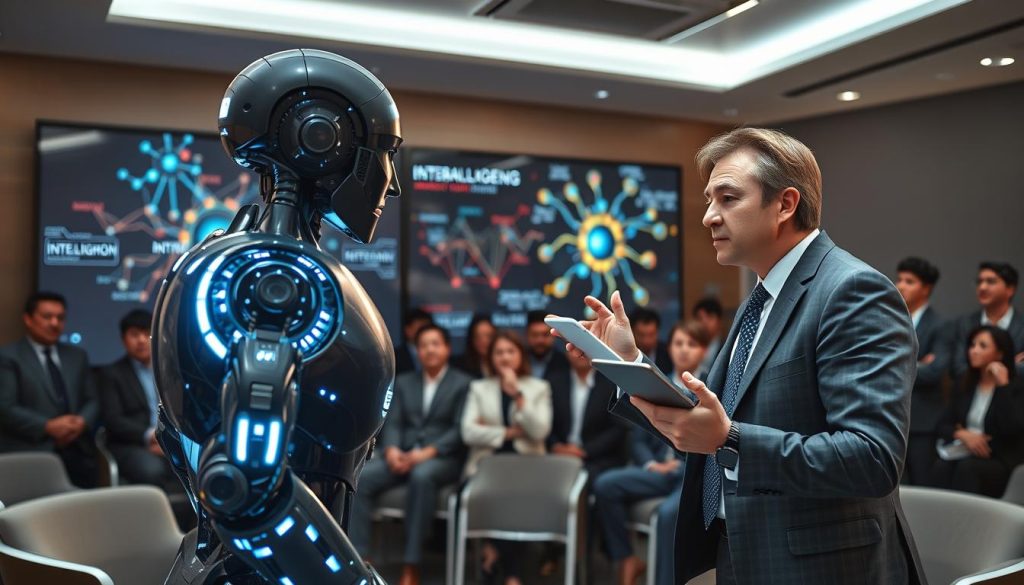
As this debate goes on and technology keeps evolving, one thing is becoming clear. Both AI and human brains are best in their own ways. Working together, AI and human knowledge could reach new highs in many areas.
Conclusion: The Future of AI and Human Collaboration
As we move deeper into the 21st century, AI becomes key in our lives and jobs. It has started a new era of working together with humans. This team-up is opening doors in many fields, making it easier to tackle big challenges and sparking creativity. Instead of fearing a gloomy future, we’re looking at a journey of working together and making each other better.
Embracing AI as a Partner
These days, we see AI not as a rival, but as a teammate. We imagine a future where human creativity and AI’s speed work together. Using AI as a partner helps us focus on what we’re good at – like thinking creatively and understanding emotions. In this team, each one boosts the other, blending detailed accuracy with creative dreams.
Preparing for an AI-Integrated Society
Getting ready for a world with AI means rethinking our learning and building better systems. We must grow in areas AI can’t and boost sectors that benefit from AI tools. As AI grows, making systems that encourage teamwork is crucial. Our goal is not just to have AI but to use it to enhance our own smarts.
FAQ
What is the history of AI development?
What are the key milestones in AI technology?
What are the characteristics of human cognition?
How does AI perform in terms of emotional and social intelligence?
What is the current state of machine learning and deep learning?
What advances have been made in natural language processing?
In what areas does AI excel?
What are the limitations of artificial intelligence?
What concerns exist over AI decision-making?
How might autonomous systems challenge our notions of morality?
How is AI serving as an augmentation tool?
What are some applications of AI in various industries?
What do experts predict regarding the future of AI development?
What are the potential breakthroughs expected in AI?
What is the concept of a superintelligent AI?
What are possible scenarios for AI exceeding human control?
What is the current state of legislation on AI technology?
Why is there a need for global AI standards?
Are there arguments supporting the belief that AI will never surpass human intelligence?
What are the arguments for AI’s potential to surpass human intelligence?
How can we embrace AI as a partner?
How should society prepare for an AI-integrated society?
About the author : virtual-glasses