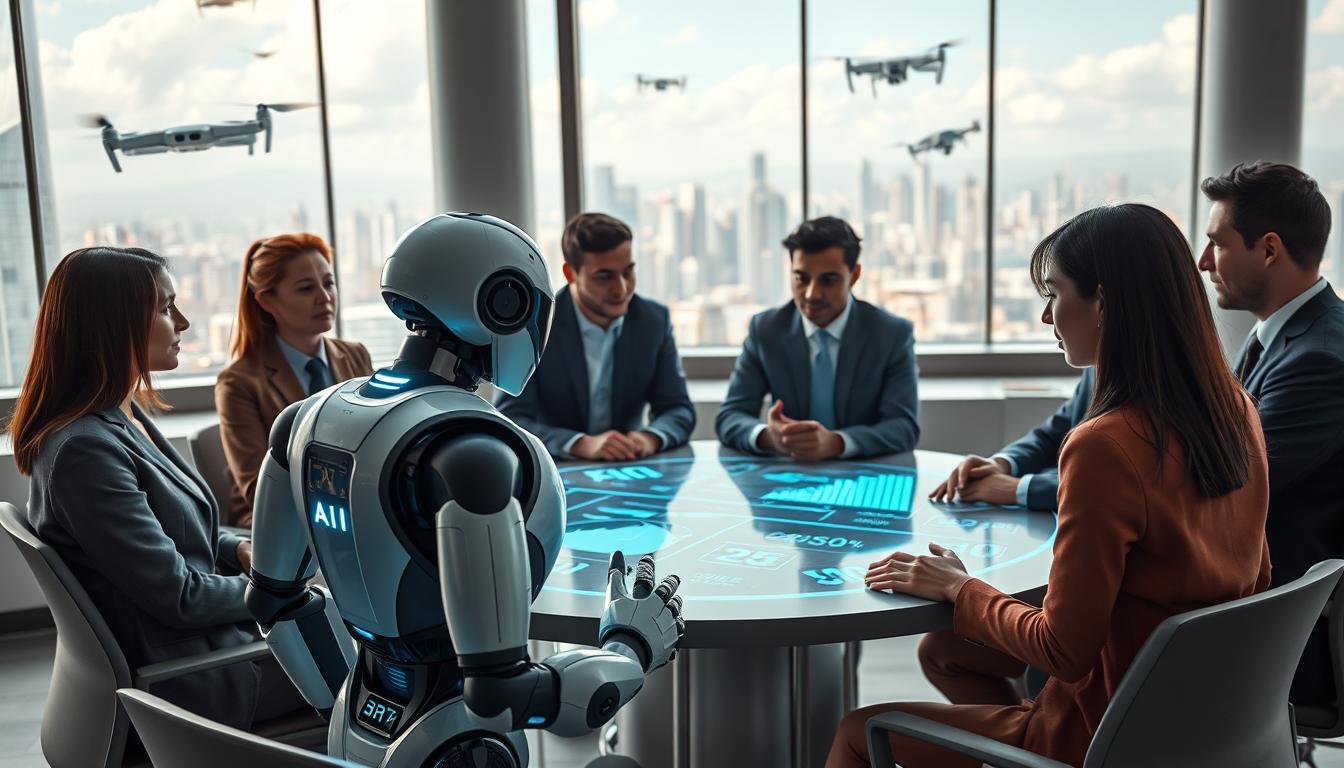
The Rise of AI: Replacing or Enhancing Human Intelligence?
In a world brimming with technology, we face a major question. Is AI taking over human intelligence? This crucial issue makes us look closely at the struggle between artificial intelligence and human thought. As we move further into a future ruled by algorithms, the fate of human brainpower is uncertain. Will the intelligent systems we’ve built end up replacing us? Or, will they help make us even smarter?
People often talk about AI in two ways – fearing an AI takeover or seeing AI as a boost to our productivity. The worry about losing jobs to AI is real. Yet, there’s also a strong belief in AI’s power to spark new ideas. With AI becoming a bigger part of our daily lives, it’s critical to separate fact from fiction about AI’s impact on our brains.
Key Takeaways
- Exploring the ongoing debate on whether AI poses a threat or an opportunity for human cognition.
- Understanding the implications of artificial intelligence on the future of human intelligence.
- Examining how AI is shaping industries and augmenting human capabilities.
- Considering the socio-economic ramifications of increasingly autonomous AI systems.
- Looking at the crucial role of AI in driving the Fourth Industrial Revolution.
Understanding Artificial Intelligence and Its Types
Questions like “Is AI taking over human intelligence?” are common today. It’s essential to know what artificial intelligence (AI) really means and its variety. AI is a big step in technology, making machines think like humans. Through computers, AI can do complex jobs, automate choices, and improve itself using machine learning. This improvement is vital for its impact on society.
AI falls into two main groups based on its ability and design goals. These differences show the technology’s range and limits in different fields.
What is Artificial Intelligence?
AI is about making algorithms and systems for computers to do tasks needing human smarts. These tasks include reasoning, understanding language, and solving problems. AI is part of software systems, making data handling and decision-making faster.
Key Types of AI: Narrow vs. General
The first type, narrow AI or weak AI, handles a single task or a few tasks. Like Apple’s Siri or auto-tagging photos on social media. On the other hand, general AI or strong AI covers much more. It aims to do any task a human can. But, it’s still mostly theoretical, with research ongoing.
Machine Learning and Deep Learning Explained
Machine learning and deep learning help AI do many tasks. Machine learning lets machines learn from data and get better without direct programming. Deep learning, a deeper type of machine learning, uses artificial neural networks. These networks, like our brain, process tons of data. These techs not only push AI forward but also change society and jobs. They make us rethink the roles AI could improve or change.
As AI grows, its effects become a key point in how it fits into our lives and work.
Historical Context of AI Development
The history of AI is filled with big moments that changed how we think and work. It shows the growth from simple ideas to real-world uses, looking at how AI and human thought compare.
A Brief History of AI Innovations
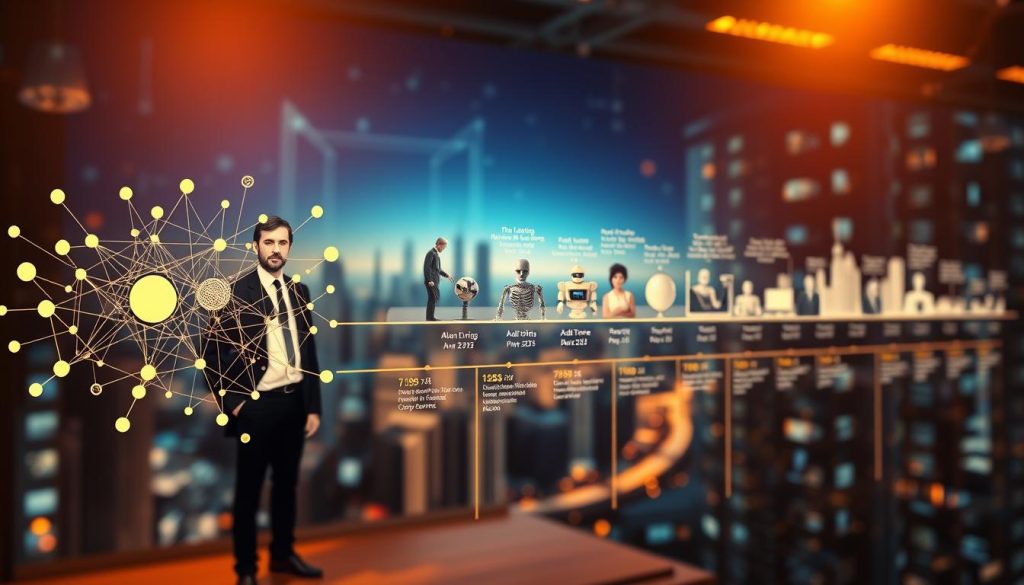
AI began as a dream in sci-fi. The term was first used in the 1950s, introducing the bold concept of machines thinking like us. Since then, we’ve seen rapid progress in creating machines that do tasks needing human smarts.
Major Milestones in AI Research
Early neural networks to IBM’s Watson, AI research has made big strides. Each discovery not just pushed tech forward but also fueled debates on AI versus human thought.
The Evolution of AI Technologies
AI has grown enormously over time, getting smarter every decade. It moved from simple codes to advanced machine learning. This progress shows the ambition and creativity of tech leaders globally.
| Year | Innovation | Impact |
|---|---|---|
| 1956 | Official coining of ‘Artificial Intelligence’ | Marked the formal start of AI as a field of study |
| 1997 | IBM’s Deep Blue defeats a world champion in chess | Showcased AI’s potential to surpass human intelligence in specific tasks |
| 2011 | Launch of IBM Watson | Fueled the integration of AI into business applications |
| 2016 | AlphaGo’s victory over a Go champion | Demonstrated advanced machine learning capabilities |
Learning about AI’s history helps us see its development and discussions on our intelligence’s future. This background is key to understanding how AI will become part of our society.
The Current State of AI Technology
Today, the growth of artificial intelligence (AI) is changing industries and how we live. AI does tasks that require human intelligence across different fields, showing that it’s more than just a future idea. It’s real and happening now.
Leading AI Technologies TodayModern AI technologies include predictive analytics and advanced machine learning. These power things like social media feeds and tools for diagnosing health issues.
Dominant Players in the AI Market
Big tech and car companies are leading in AI development. They’re making big moves, shaping how AI grows and how it is regulated.
AI’s Impact on Various Industries
AI is bringing big changes to healthcare, finance, and cars. It’s making disease diagnosis and patient care better in healthcare.
In finance, AI makes handling money and risks smoother. In the car industry, it’s working on self-driving cars and making driving safer.
| Industry | AI Application | Impact |
|---|---|---|
| Healthcare | AI-assisted diagnostics | Increased accuracy and faster diagnosis |
| Finance | Automated risk assessment | Enhanced decision-making and efficiency |
| Automotive | Autonomous driving technologies | Improved safety and innovation in mobility |
AI’s growth doesn’t just show our tech progress. It also brings up important talks about rules, using it right, and its role in our future society. As AI keeps changing, we need to keep understanding its effects and how it shapes our world.
The Argument: Is AI Replacing Human Intelligence?
The debate on AI replacing human smarts is hot right now. Advances in AI are pushing what machines can do, from automating tasks to sparking big ethics talks. We’re looking into if AI can take over human roles and checking how AI matches up to our complex brains.
Analyzing the Replacement Hypothesis
As AI gets better, it can do more things, from simple to really complex stuff. This move is mostly about being more efficient, saving money, and being safer at work. AI is already at work in assembly lines, customer service, and even surgeries, doing things faster and more precise than humans. But this doesn’t mean AI will take over completely. It’s more about changing the job scene.
Limitations of AI Compared to Human Intelligence
Even with all its skills, AI can’t do everything we can. Things like reasoning, feeling, being creative, and making deals are tough for AI. For jobs that need a personal touch, like HR or customer talks, AI can’t quite connect like humans. The big AI ethics debate makes using AI even trickier, bringing up privacy and fairness issues.
In the end, AI is growing and taking on more tasks, but won’t replace human intelligence everywhere. Think of AI as a helper to our skills, knowing it has limits and ethical challenges to face.
The Counterargument: AI as an Enhancement
A lot of people worry that artificial intelligence (AI) might take away jobs. But, many experts and studies are now seeing it in a brighter light. They think AI can make human intelligence even better. It can help us do things in new and exciting ways.
AI is really good at doing automated tasks. This makes things more efficient in many areas. It lets people focus on jobs that need more creativity and strategy. In fields like design, music, and science, AI tools help us discover and create new things. This brings out the best in how humans and machines work together.
But, we can’t forget about the ethics of using AI. We have to use it carefully to make sure it does good without stepping on our privacy or freedom. We face the challenge of making AI help us, not take away the human touch in what we do.
| Industry | AI Application | Human Benefit |
|---|---|---|
| Healthcare | Data Analysis | Enhanced Diagnostic Accuracy |
| Finance | Automated Trading Systems | Improved Decision-Making Capabilities |
| Manufacturing | Robotic Assembly Lines | Reduced Human Workload & Increased Safety |
AI is becoming more like a helpful partner in all kinds of jobs, from simple to very complex. This partnership is making us think differently about being productive and creative. It’s important that we use AI to add to what we can do, not to take our place.
The Economic Implications of AI
AI is not just changing technology, but it’s also a big economic player. It brings changes to jobs and how workspaces look. Topics like machine learning impact on society, technological singularity, and future of human intelligence are key to understanding these changes.
Job Displacement Concerns
By 2025, experts believe millions of jobs could be lost to AI and automation. While this shows AI’s disruptive side, it also starts a conversation on how workers can adapt and stay strong in a digital world.
Opportunities Created by AI Technology
Yet, AI isn’t just about job loss. It’s expected to create about 97 million new jobs by 2025. These jobs will be in digital and tech areas, reshaping career paths and the skills people need.
The Future of Work in the Age of AI
AI is changing what the future of work looks like. Jobs will have to become more tech-focused and adaptable. Learning new skills becomes key as employees aim to keep up with AI-driven job trends.

| Aspect of Change | Impact by 2025 |
|---|---|
| Jobs Displaced | Millions across sectors |
| Jobs Created | Approximately 97 million |
| Skills Required | Upskilling in tech fields |
This table shows AI’s economic impact from two sides: it’s making new jobs but also ending old ones. The key is to ready the workforce with the right education and training for the AI-influenced job market.
Ethical Considerations Surrounding AI
The AI ethics debate is becoming more important as AI becomes part of our lives. It’s crucial for AI to respect privacy, be fair, and follow strict rules. How we address these matters shows what we value and the future we’re aiming for.
One major concern is how AI deals with private information. Trust is built when users feel their data is secure. Plus, AI must have strong protections against cyber dangers.
A big problem is AI’s potential bias, which can harm fairness. If AI learns from biased data, it might make unfair decisions. So, making AI fair for everyone is a constant goal.
Setting up the right rules for AI is key. Authorities need to make sure AI is safe, ethical, and unbiased. These guidelines help tech grow safely while protecting people’s rights.
AI’s advancement shouldn’t ignore ethics. Balancing innovation with rules is tough but needed. As AI improves, our methods to ensure it benefits everyone should too.
AI in Everyday Life
Artificial intelligence (AI) is changing how we do everyday things, making tasks easier and healthcare better. It helps with everything from running our homes to improving medical diagnoses. This shows how AI is becoming a big part of our lives and our thinking.
Applications of AI in Daily Activities
Most of us use AI every day, maybe without knowing it. For example, Alexa and Siri help us set reminders and play music. This shows how AI is making our lives easier. Smart home devices also use AI to control things in our houses, making everyday tasks simpler.
How AI is Revolutionizing Personal Productivity
In jobs, AI is doing things like analyzing data and handling routine tasks. This lets people focus on creative and strategic work. It’s making us more productive by combining AI with human skills.
The Role of AI in Healthcare and Medicine
The healthcare sector is seeing big benefits from AI. It’s used for diagnosing diseases more accurately and suggesting treatment plans. For example, robots are now used in surgeries for better precision, leading to faster recovery times. AI is making a big impact on medicine, improving how we care for patients and run operations.
AI is also great at working with huge amounts of medical data. This helps a lot in creating new medicines and treatments, speeding up research. It could even help save lives by finding new ways to fight diseases.

| Industry | AI Application | Impact |
|---|---|---|
| Personal Assistants | Task Scheduling, Environment Control | Enhanced daily convenience and efficiency |
| Healthcare | Diagnostics, Robotic Surgery | Improved accuracy and patient care |
| Productivity Software | Data Analysis, Automated Reporting | Increased workplace productivity |
AI is getting better at tasks that seem like human thinking, from personal help to professional tasks. This is making work easier and helping industries offer more advanced services. It’s a trend that shows how AI can work alongside human skills to improve productivity and services.
Future Trends in AI Development
The path of AI will greatly change what humans can do and how society works. Key trends in AI’s growth are merging with new technologies. This mix is expected to boost human intelligence and create sustainable AI ways.
This growth ties closely to the idea of the technological singularity. That’s when AI might get smarter than humans, bringing both risks and chances.
AI’s future seems headed towards machines that think and improve human thoughts. This advance shows big impacts of AI from health care to self-driving cars. It marks a big change in achieving societal progress.
Technologies like quantum computing and biotech play a big role in this change. Their mix with AI might solve problems we can’t yet. They might make AI systems more strong, efficient, and flexible, helping various fields grow sustainably.
Another part of AI’s future is making AI that’s good for the economy, environment, and society. This means making AI that uses less energy, handles data better, and helps important goals like lowering carbon emissions and adding to social fairness.
- Reduction of AI’s carbon footprint through more energy-efficient computing processes.
- Enhanced decision-making capabilities in AI that factor in ethical considerations to promote fairness and reduce bias.
- Development of AI-enabled systems that support global sustainability initiatives, such as disaster response and resource management.
The Human-AI Interaction
Humans and artificial intelligence (AI) are finding new ways to work together. We are making AI more emotionally intelligent. This lets us build better partnerships between people and machines. These advances help create systems that get our instructions and the feelings behind them.

Enhancing Communication between Humans and AI
We’re working to improve how we talk to AI. The aim is to have AI understand and show human emotions. This will make it easier for us and AI to get each other, especially in customer service and healthcare.
Emotional Intelligence in AI Systems
Teaching machines to understand our emotions is key. This is especially important in places like therapy or when solving disagreements. It helps us bond better with technology, making our interactions feel more natural.
| Feature | Benefits | Application Examples |
|---|---|---|
| Emotion Recognition | Improves user interaction, personalizes responses | Virtual customer assistants, therapeutic bots |
| Contextual Understanding | Enhances the relevance of AI responses | Smart home devices, interactive learning tools |
| Adaptive Learning | AI adjusts to user’s emotional state and preferences | Predictive healthcare monitoring, personalized tutoring systems |
These leaps in AI’s emotional smarts and communication are changing our tech expectations. They’re taking human-machine teamwork to new heights.
Conclusion: The Coexistence of AI and Human Intelligence
The journey through technology brings us to a question. We wonder if “AI is replacing human intelligence?” This question grows into a bigger talk about AI and human intelligence living together. This relationship is about working together, not fighting.
AI is a strong tool that makes humans do more. It has started a new time of innovation and solving problems with AI’s help. As AI grows with us, it combines computer accuracy with human creativity. This mix makes our society better.
Building a Future with Complementary Intelligence
The future calls for a blend of human and AI intelligence. We can make technologies that help us explore new ideas, not just do tasks. AI can help us think better, be creative, and solve tough problems. This shows AI and humans can work together, leading to many chances for growth.
Preparing for an AI-Integrated Society
Getting ready for a future with AI means being prepared at all levels. We need to teach people how to use AI well. Environments where humans and AI work well together are key. It’s up to teachers, leaders, and policymakers to make this happen. They must keep ethics, people-friendly designs, and including everyone in mind.
We must welcome AI and human intelligence living together. It’s essential for building a stronger, smarter world.
FAQ
What is Artificial Intelligence?
Key Types of AI: Narrow vs. General?
Machine Learning and Deep Learning Explained
A Brief History of AI Innovations
Major Milestones in AI Research
The Evolution of AI Technologies
Leading AI Technologies Today
Dominant Players in the AI Market
AI’s Impact on Various Industries
Analyzing the Replacement Hypothesis
Limitations of AI Compared to Human Intelligence
How AI Augments Human Capabilities
Case Studies of AI-Human Collaboration
Job Displacement Concerns
Opportunities Created by AI Technology
The Future of Work in the Age of AI
Privacy and Data Security Issues
Bias and Fairness in AI Systems
The Role of Regulation in AI Development
Applications of AI in Daily Activities
How AI is Revolutionizing Personal Productivity
The Role of AI in Healthcare and Medicine
Predictions for AI’s Evolution
The Role of Emerging Technologies
Sustainable AI Solutions for the Future
Enhancing Communication between Humans and AI
Emotional Intelligence in AI Systems
Building a Future with Complementary Intelligence
Preparing for an AI-Integrated Society
About the author : virtual-glasses