The Ethics of AI: Can Machines Develop Values?
Can AI systems learn to understand human values and ethics? As AI takes on roles in healthcare, finance, governance, and social interactions, its connection to our moral values becomes more complex. This raises important questions about the ethics of AI. People are debating whether AI can be aligned with our moral values. They are looking into how AI should be developed ethically and the big philosophical questions this technology brings up.
At the heart of the debate is whether AI can reflect society’s norms and values. It also explores the new challenges and opportunities AI brings to rethinking what ethical behavior means. As AI becomes a bigger part of our lives, the implications are significant. We must consider if AI’s influence will change how we view and practice morality in society.
Key Takeaways
- Exploration of AI’s potential to align with human ethical standards.
- Insight into how artificial intelligence ethics is shaping debates about technology’s role in society.
- The significance of moral AI development in various facets of human activity.
- Understanding the philosophical implications of AI on our conventional sense of ethics.
- Evaluation of the relationship between societal values and the evolution of AI technology.
Understanding AI and Machine Learning
The rise of artificial intelligence and machine learning has changed many areas, bringing new levels of innovation. Understanding these technologies is important. We need to know what they are, what they can do, and their limits compared to our own brains.
Definition of Artificial Intelligence
Artificial intelligence is about making machines think like humans. These include learning, reasoning, and fixing their mistakes. AI aims to make machines do things only humans used to do. For example, understanding pictures, recognizing voices, and making decisions based on right and wrong.
Overview of Machine Learning Techniques
Machine learning is a part of AI that lets systems learn and get better on their own. This happens through algorithms that look at data, learn from it, and use that knowledge to make smart choices. There are different ways machines learn. Some need humans to guide them. Others can find patterns in data by themselves.
Differences Between AI and Human Intelligence
AI can be faster and more accurate than us in some tasks. But humans are still better at being creative and making moral choices. Even with progress in machine learning, AI can’t match us in these areas yet. Trying to teach AI right from wrong is tough because human values are complex.
The Concept of Values in Human Society
Understanding how values shape decisions and norms in society is key. Values are the foundation of how societies operate. They affect every part of how people interact and make choices. As artificial intelligence (AI) becomes a bigger part of our lives, talking about AI value alignment is crucial.
What Are Values?
Values are the rules that guide how we act and make decisions. They show us what’s important in life. These are shaped by our culture, faith, and personal experiences. They help us know right from wrong. For those teaching ethics to AI, understanding these values is the first step. This helps make algorithms that follow human ethical standards.
The Role of Values in Decision Making
Values help us choose what’s most important when making decisions. In AI value alignment, it means making machines act according to human values. This needs a good grasp of society’s rules, both spoken and unspoken.
It’s vital for AI to match human values in its ethical framework. This isn’t just to stop AI from making bad choices. It’s to make sure AI supports our societal norms.

The talk about AI and ethics needs to grow as technology evolves. This ensures AI systems push our society forward, not back. It’s important to think about the kind of morals we want in our future AI.
The Current State of AI Technologies
AI technologies are now used in many fields like healthcare, finance, and education. They help in creating financial strategies and improving patient care. AI is becoming a big part of our lives, hinting at a future where it solves more complex problems.
But, this growth of AI comes with its own set of challenges. AI systems often struggle with understanding human values and morals. This makes it hard for AI to align with our ethical standards unless humans guide it.
This situation shows why we must keep researching AI and its values. We need AI systems that can make decisions that match our society’s norms and personal ethics. This is crucial as we let AI handle important decisions in healthcare, law, and finance.
The Challenge of Encoding Values in AI
Merging values with artificial intelligence (AI) is tough. It’s about blending tech growth and human ethics. This task goes beyond simple coding, touching the heart of AI moral frameworks, ethical dilemmas, and complexity of values.
Trying to mix ethical behavior into AI raises many issues. It’s about making systems that understand and weigh human values in tough situations.
Ethical Dilemmas in AI Programming
When developing AI, we face critical choices on what morals to follow. These ethical dilemmas aren’t just theoretical. They deeply influence how we live with AI technologies.

The Complexity of Human Values
Fitting values into AI is tricky because human ethics are complex and often conflict. What’s right varies across cultures and people. Making AI that respects this complexity of values is a challenging and delicate task.
This table shows the difference between normal programming and programming AI with human values:
| Traditional Programming | Value-Based AI Programming |
|---|---|
| Issue clear, static commands | Encode nuanced, evolving ethics |
| Predictable outcomes | Unpredictable ethical implications |
| Technical bugs | Moral dilemmas |
| Data-based decisions | Decisions requiring moral judgment |
The differences highlight the challenges of applying human ethics to AI. Success needs tech innovation and active work with ethical studies and AI moral frameworks.
Models of AI Value Learning
Artificial intelligence (AI) is becoming a big part of our daily lives. It’s important for AI to understand right from wrong. Techniques in AI help create systems that act ethically.
Approaches to Value Alignment
Different methods help teach AI about ethics. Reinforcement learning is key. It helps AI make choices that are morally good based on positive feedback. This helps AI learn morality in a practical way.
Case Studies on Value-Learning Systems
Looking at real-life examples shows how far AI value learning has come. These examples show both the challenges and wins in making AI ethical.
| System | Technique Used | Outcome |
|---|---|---|
| Customer Service Bots | Reinforcement Learning | Improved response accuracy and ethical handling of customer data |
| Healthcare Management AI | Supervised Learning | Adherence to privacy laws and ethical treatment recommendations |
| Autonomous Vehicles | Deep Learning & Simulation | Enhanced decision-making in morally complex traffic scenarios |
This exploration highlights the progress in making AI align with our ethical values. It shows how learning and adapting are key.
The Impact of Human Bias on AI Values
As AI grows and blends into different areas of life, the bias in artificial intelligence becomes a key problem. It shapes the technology’s ethics and role in society. The data that trains AI often carries past human biases, putting these biases into how AI works. We’ll look at how these biases touch AI values and their wider effect on society.
Bias in Training Data
Training data bias is a huge hurdle in AI growth. These biases slip into AI through unrepresentative datasets or those with old prejudices. When AI learns from this data, it might continue social inequalities. For instance, an AI trained mostly on data from one group might fail to serve other groups well. This can create unfairness in its uses.
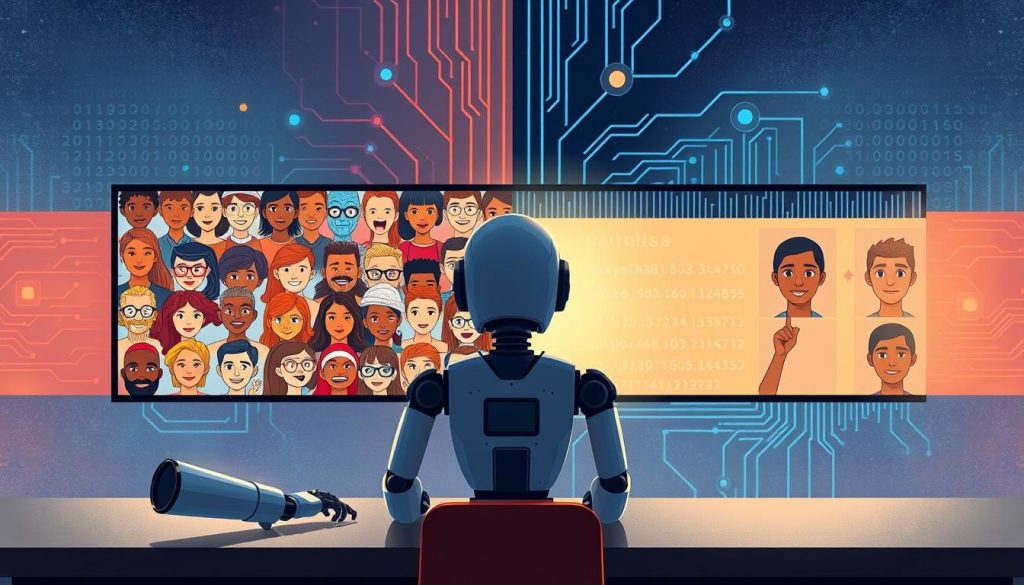
The problems caused by AI bias are wide and can harm many areas. They include law enforcement, job hiring, healthcare, and banking. Biased AI can lead to unfair policing, biased job algorithms, and unfair healthcare. These issues not only keep social gaps but also weaken trust in AI. This makes developing ethical AI systems harder.
To tackle these AI ethical issues, there must be teamwork. Developers, researchers, and policy makers need to work together. They should make AI data sets more inclusive and create algorithms that spot and reduce bias. By actively fighting bias in AI, we aim to lessen its social harm. And we aim to make these technologies fairer and more effective.
Philosophical Perspectives on AI Values
When we dive into the philosophical implications of AI, it’s essential to consider how ideas like utilitarianism and deontological ethics fit into AI’s programming. This blending enriches our grasp of AI’s impact on society. It also calls for a thoughtful way to manage its ethical side.
Utilitarianism and AI Decision Making
Utilitarianism values actions that boost happiness for most people. In AI decision-making, this approach can lead AI to act in ways that help a large number of people. This is seen in healthcare, where AI could make choices that do the greatest good.
Deontological Ethics in AI Programming
Deontological ethics focus on following rules and duties, no matter the result. When we use this with AI, it means making AI systems that stick to strict ethical guidelines. However, putting these complex rules into AI systems is a big challenge.
Discussing AI’s philosophy brings up big questions about balancing outcome-based and rule-based ethics. As AI grows, the mix of utilitarianism and deontological ethics will be key in guiding the choices machines make, affecting us all.
The Role of Oversight in AI Value Development
As AI grows, the need for strict AI ethics oversight grows too. It’s crucial for making sure AI matches our values. Setting up strong regulatory frameworks in AI is vital, not just paperwork but a key step for ethical AI development. This keeps AI legal and ethical, protecting human rights and respect.

Creating and applying these rules needs teamwork across fields like tech, ethics, and policy. The aim isn’t to slow down tech advances. It’s to ensure AI grows safely and ethically, benefiting everyone without causing harm or being used wrongly.
Here’s a brief look at some key ethical guidelines for AI:
| Organization | Guideline Focus | Key Elements |
|---|---|---|
| IEEE | Transparency | Enforcing clear AI algorithms, understandable for users and developers. |
| EU Commission | Accountability | Audits for high-risk AI, ensuring they meet ethical standards. |
| United Nations | Privacy and Data Protection | Rules to keep citizen data safe and limit watching too closely. |
Case Studies in AI Value Implementation
Two main areas, AI in self-driving cars and AI in healthcare, show how tech meets complex ethical issues. These examples bring to light how technology works with deep human values.
Autonomous Vehicles and Ethical Dilemmas
Self-driving cars use AI to make quick, important decisions. They must consider the safety of people inside and outside the vehicle and follow traffic rules. They sometimes face tough choices, showing why it’s key to include ethical thinking in AI.
AI in Healthcare and Moral Decisions
In healthcare, AI helps decide who gets medical care first. It supports doctors in treatment choices, keeping in mind what’s morally right and what patients agree to. AI’s ability to analyze lots of data helps make better, ethical choices.
| AI Application | Focus of Ethical Dilemma | Significance in AI Development |
|---|---|---|
| Autonomous Vehicles | Decision making in crisis situations | Tests limits of AI in mimicking human ethical decision-making |
| Healthcare | Prioritization of patient care | Integrates ethical reasoning in clinical settings |
These studies help improve AI and shape the rules for making moral choices in tech development.
Future Prospects for AI Value Learning
The relentless evolution in artificial intelligence hints at a promising but challenging future. This is particularly true for AI’s ethical abilities. As we look ahead, understanding AI trends and their effects on society is essential.
Researchers are working hard to build AI systems that can think ethically. This step is key, not just for new AI tools but to ensure these technologies act in ways that match our values and norms. Let’s look at some important trends and what they might mean.
Trends in AI Research and Development
AI research is moving towards transparency and accountability. Developers are making systems that are smart and can explain their choices. This move is part of a bigger effort to create AI that is ethical and effective.
Potential Implications for Society
The impact of AI on society is deep and wide. As AI becomes part of areas like healthcare and finance, its ethical behavior is crucial. Ethically tuned AI will build trust and improve human-machine relations.
The future is bright, but challenges remain. AI is developing fast, possibly faster than we can manage. Therefore, discussing its ethical aspects is critical for our future steps.
Our shared goal is to guide AI development towards systems that are intelligent and ethically aware. Balancing technology growth with ethical care will lead to a future where AI and humans benefit each other.
Public Perception of AI and Ethics
Artificial intelligence (AI) is merging into our lives quickly, changing how we view AI. People’s feelings range from excitement to worry. We explore the deep concerns and ethical questions that AI raises in society.
Understanding Societal Concerns
People have many worries about AI. These include losing jobs, less privacy, and AI making big decisions. There’s also fear about AI’s “black box” making it hard to see how decisions happen and who’s accountable.
The Debate on AI Autonomy and Ethics
The debate on AI ethics gets heated as AI grows smarter. Talks focus on creating ethical rules for AI to make sure they match our values and societal norms. Ideas for ethical AI include setting up regulatory groups and having public discussions to understand people’s concerns.
| Concern | Public Opinion | Proposed Solutions |
|---|---|---|
| Privacy | Negative | Stricter Data Regulations |
| Job displacement | Mixed | Re-skilling Programs |
| Decision transparency | Low Trust | Clearer Algorithm Disclosure |
Conclusion: The Path Forward for AI and Values
The journey to ethical AI is crucial in today’s tech world. It matters greatly how artificial intelligence blends with our values. We must think carefully about how to do this right.
Bringing machines into our lives offers great chances but also raises big questions. We need to move forward with both hope and caution.
Summary of Key Insights
We have learned a lot about AI and its values. Knowing how AI and machine learning work helps us see what needs to be done. This knowledge is key to making ethical AI.
Understanding human values and how they guide decisions is vital. It’s complex to fit these values into AI, but it’s important.
Call to Action for Ethical AI Development
Everyone plays a part in making ethical AI. This includes lawmakers, tech experts, and all of us. We have to keep talking about what is right, keep a close eye on AI, and get everyone involved.
We can make sure AI grows in a good way if we all do our part. Working together is the best way to protect our future with technology.
FAQ
What is Artificial Intelligence?
How does machine learning work within AI?
In what ways does AI differ from human intelligence?
What are values in the context of human society?
How do values play a role in decision-making?
What are some popular applications of AI technologies today?
What are the limitations of current AI systems?
What ethical dilemmas arise from AI programming?
What challenges are there in translating human values into AI?
What are some approaches to AI value alignment?
Can you provide examples of AI systems learning values?
How does bias in training data affect AI values?
What are the societal consequences of AI bias?
How might utilitarianism influence AI decision-making?
What is the role of deontological ethics in AI programming?
Why are regulatory frameworks important for AI?
Can you give examples of ethical guidelines for AI?
What ethical challenges do autonomous vehicles present?
How is AI being used to make moral decisions in healthcare?
What research and development trends are shaping AI value learning?
What implications could AI value learning have for society?
What concerns do the public have about AI and ethics?
Why is the debate on AI autonomy and ethics significant?
About the author : virtual-glasses