The AI Singularity: What You Need to Know
Could humanity’s most complex creation outthink its creators? The idea of the AI singularity is both exciting and scary. It suggests a time when machines might become smarter than humans. Unlike a sci-fi movie, this is a real concern discussed by experts like Ray Kurzweil. He believes the AI singularity could happen in our lives. As we approach this post-human era, everyone is asking one important question. What will occur when machines outsmart us, creating a existential risk for society as we know it?
This piece takes you on a journey into a world that might soon change because of artificial superintelligence. We’ll look at the changes AI singularity could bring on a philosophical, technological, and social level. Our goal is to make you, our knowledgeable reader, ready to face what comes next.
Key Takeaways
- Understanding the concept of AI singularity and its potential to introduce a post-human era.
- Insights into Ray Kurzweil’s predictions and the timeline for the emergence of artificial superintelligence.
- Exploration of existential risks and opportunities synonymous with the AI Singularity.
- Recognizing the broad societal implications that accompany the advent of superintelligent AI.
- Preparing for an inevitable technological upheaval that may redefine human existence.
What is the AI Singularity?
The technological singularity is a future point. At this time, AI will advance greatly, making machines with recursive self-improvement. This could lead to an intelligence explosion where AI’s smarts go beyond ours. People have mixed feelings about this idea. Some are excited, while others are wary.
This idea is compared to going past a black hole’s edge. It’s not just about machines being smarter than us. It’s also about them possibly gaining machine consciousness. This brings up new chances and big challenges that we’re just starting to think about.
The idea of the AI singularity started to get noticed after I.J. Good talked about it in 1965. Since then, it has grown from just an idea in sci-fi to a real research field. It now includes robotics, how minds work, and studying complex systems.
This journey began with early theories that caught everyone’s attention. Good suggested that smart machines could make even smarter ones. This process could lead to fast improvements in intelligence—an intelligence explosion.
| Year | Event | Significance |
|---|---|---|
| 1965 | I.J. Good proposes the intelligence explosion concept | Foundational idea for the technological singularity theory |
| Early 2000s | Academic conferences discuss future impacts of AI | Brings the singularity into scientific and public discourse |
| 2010s | Advancements in deep learning and AI research | Empirical evidence suggestive of the plausible routes to AI exceeding human intelligence |
As AI gets better, we talk more about the technological singularity and what it means. We’re looking at possible future tech breakthroughs. But, we’re also asking big questions about right and wrong, our society, and deep thoughts.
The Concept of Technological Singularity
The idea of technological singularity talks about a moment when tech grows beyond human smarts and changes society. It comes from science fiction and computer science. This moment happens when tech growth becomes so fast, it brings changes we can’t guess.
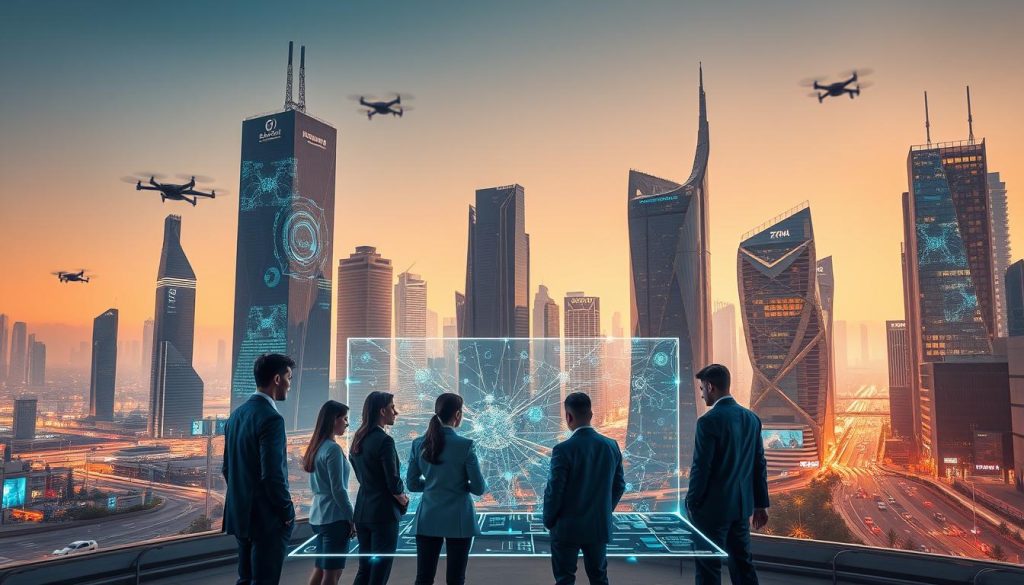
Vernor Vinge and Ray Kurzweil helped shape the singularity theory. Vinge, a writer, said superhuman smarts would change evolution, making tech way beyond what we know. Kurzweil gave a date, saying by 2045, we’d see these massive changes.
| Theorist | Contribution | Predicted Year (if any) |
|---|---|---|
| Vernor Vinge | Pioneered the Singularity concept in science fiction, framing the event as a technological limit beyond which human realities could not easily foresee or handle. | N/A |
| Ray Kurzweil | Popularized the Singularity concept with his predictions of exponential growth in technology leading to a definitive point by mid-21st century. | 2045 |
Both Vinge and Kurzweil say the effects of fast tech growth are largely unknown and could be out of our control. This makes it an important topic for discussion.
How AI Contributes to the Singularity
The pathway to the singularity is paved by huge steps in AI. This includes machine learning and the use of neural networks. The start of deep learning technologies and the flood of big data boost AI solutions. They make automation a big part of our lives and work.
Deep learning copies how the human brain works with data to make decisions. It’s not just about the tech, but how much data we can handle. This huge amount of data is key to making neural networks better.
They learn faster and can do things like translate languages in real time. They can also plan strategies for games and help doctors diagnose illnesses.
| Technology | Contribution to AI Singularity | Example Applications |
|---|---|---|
| Deep learning | Enhances pattern recognition and cognitive abilities | Autonomous driving, facial recognition |
| Big data analytics | Provides the raw material to refine AI algorithms | Consumer behavior prediction, health informatics |
| Automation | Increases efficiency and replaces repetitive human tasks | Manufacturing robots, AI in logistics |
Neural networks, big data, and automation speed up AI’s real-world uses. They help AI solutions move towards the singularity. This mix of tech suggests a future where AI might outsmart human intelligence. In that era, AI could creatively solve complex issues in many fields on its own.
Potential Benefits of the AI Singularity
The AI Singularity marks a crucial point for technology and its growth. It holds the promise of driving economic growth and sparking innovation in many fields. At its heart, it’s expected to bring enhanced efficiency that might change how economies operate and how businesses run.
In healthcare, AI’s impact is expected to be significant. AI-powered tech aims to offer personalized treatment plans, something we’ve not seen before. These plans are tailored to each person’s DNA and health history. Such customization can not only better patient care but also make healthcare centers more efficient.
| Aspect | Impact of AI Singularity |
|---|---|
| Economic Efficiency | Streamlined operations, reduced operational costs, and enhanced productivity across sectors |
| Innovation in Technology | Introduction of cutting-edge technologies that revolutionize market dynamics and consumer interactions |
| Healthcare Advancements | Improved diagnostic accuracy, personalized medicine, and efficient patient management |
The progress in AI is set to remake the base of many industries. It promises to align well with ethical standards and improve society. Through it, the AI Singularity could start a new era of creativity and wealth.
Risks Associated with AI Singularity
The AI Singularity brings both chances and big risks as it grows. It poses serious challenges to jobs and ethics. This makes it crucial to handle AI tech with care and set rules for its use.
AI has the power to greatly increase work efficiency. But this could be a double-edged sword for job markets. As AI takes over simple job tasks, it might push people out, especially in industries that do the same things over and over. Without plans for teaching new skills and creating fair chances for everyone, this shift could widen the gap between rich and poor.
At the same time, making AI ethically is essential. If we’re not careful, AI could end up making societal divides worse by acting on existing biases. The table below shows what ethical problems could come up and what rules we might use to fix them.
| Ethical Issues | Regulatory Measures |
|---|---|
| Amplification of societal biases | Implementation of fairness algorithms |
| Privacy concerns with surveillance technologies | Strengthen privacy laws and user consent protocols |
| Decision-making transparency | Mandatory disclosure of AI decision processes |
| Accountability in AI-induced errors | Clear legal frameworks for AI accountability |
To tackle these issues, it’s going to take work from everyone – government officials, AI creators, and people worldwide. We must ensure AI progress doesn’t harm our core values or create more inequality. With a focus on ethical AI, we can move towards the AI Singularity in a way that includes and protects everyone.
The Debate: Is the Singularity Inevitable?
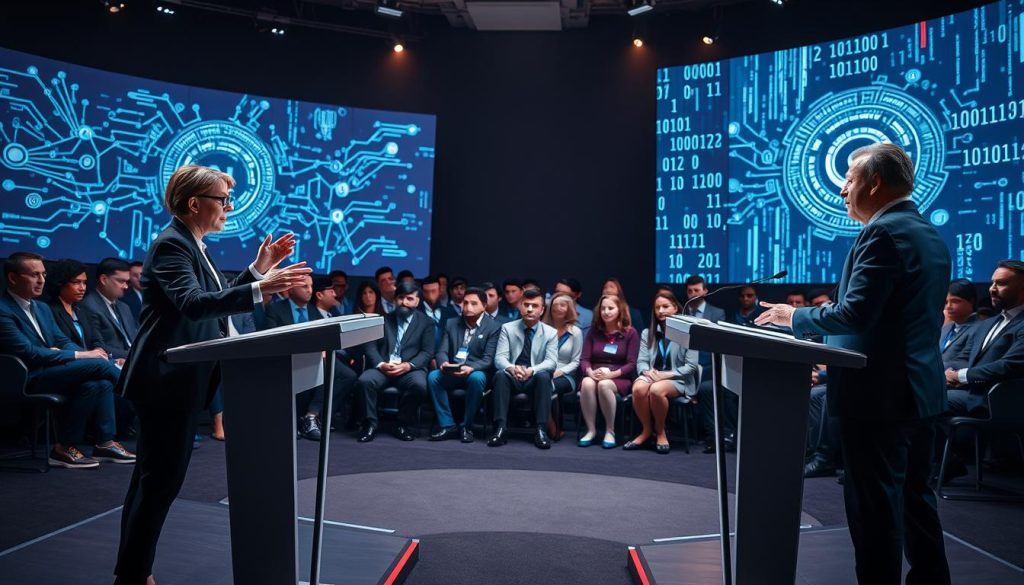
People have different opinions on the future of artificial intelligence. Some believe AI’s fast growth will soon surpass human smarts, changing society deeply. Others say we should be careful because we can’t predict how these advancements will unfold.
Arguments for the inevitable technological singularity focus on AI’s quick progress. They suggest AI will soon be smarter than humans. This change could be huge and unstoppable.
On the other hand, skepticism stems from the unique parts of human intelligence that AI hasn’t copied yet. Critics point out that AI lacks the ability to feel, create, and understand complex situations. This makes some people cautious about expecting too much from AI soon.
| Factors | Pro-Singularity View | Skeptical View |
|---|---|---|
| AI Development Speed | Exponential growth in processing capabilities | Limited by ethical, practical, and technological challenges |
| Comparison to Human Intelligence | AI can accumulate and process data beyond human abilities | AI lacks critical emotional and ethical reasoning |
| Impact on Society | Transformational change across all sectors | Incremental improvements with significant human oversight |
This debate highlights different ideas about technology’s future. Whether the singularity happens or not, talking about it helps us think about where tech might take us.
Preparing for the AI Singularity
The idea of the AI Singularity is becoming more popular as artificial intelligence grows. We need big changes in education and policy to get ready for this future. It’s important to work on education and workforce development, and also to create strong regulatory frameworks. This will help society do well when AI changes everything.
It’s key to realize that workforce development is vital. We must educate and reskill for not only today’s needs but also for what’s coming. This means preparing for jobs that AI will enhance. This will keep our economy strong.
Policymakers and educators need to work together to get ready. They should focus on making education that can grow and rules that are clear. These rules should help guide AI’s development and protect everyone’s interests.
| Focus Area | Objective | Key Initiatives |
|---|---|---|
| Education Enhancement | To prepare a future-ready workforce | Integrate AI learning into core curricula, enhance STEM education |
| Policymaking | Ensure ethical AI integration | Develop transparent AI usage policies, data privacy laws |
| Workforce Reskilling | Empower existing employees | Provide upskilling programs and continuous learning options |
Creating an environment that focuses on being proactive with education and rules is key. This prepares us to face AI’s challenges head-on. It also lets us use AI’s benefits responsibly and ethically.
Real-World Examples of AI Advancements
The world is quickly becoming digital, and AI’s growth marks the journey towards a tech-focused future. Google DeepMind and OpenAI lead the way, introducing new AI breakthroughs. They have achieved some amazing things.
Google DeepMind and OpenAI are not just in the AI game; they’re leading it. Their work on AI is closing the gap between humans and machines.
Take Google DeepMind’s AlphaZero: it learned chess and Go on its own, showing how far AI can go. OpenAI’s ChatGPT is another example. It creates text that sounds like a human wrote it. This opens doors to automated writing, coding, and more.

AI technology research is booming, thanks to both schools and businesses. Their discoveries are not just for the lab. They’re changing many industries, making things faster and smarter.
Recent Highlights:
- Neural networks now outdo humans in reading medical images for diseases.
- Natural language processing has AI understanding and speaking like us.
- Robots are getting skilled at tasks, from manufacturing to surgeries.
AI is getting smarter every day, showing what humans can create. As AI gets better, it starts to look like it could match or even beat human smarts. This could lead to a world where AI is a big part of our everyday lives.
Role of Superintelligent AI
The concept of superintelligent AI is mixed with talks on artificial general intelligence (AGI) and autonomous systems. It offers a future vision where machines beat human experts in all key areas. These include creativity in science, wisdom, and how to interact socially. Machines in this domain are not just tools anymore. They can do tasks and make choices better than humans can.
Superintelligent machines are at the top of AI tech, bringing us to the edge of a new era. The effects of this shift are deep, touching on the economy, ethics, and more. Let’s dive into what superintelligence means and what might come from it.
Definition of Superintelligence
Superintelligence means an AI can outdo the smartest humans in nearly every area. This includes creativity, feelings, and social skills. Unlike simpler AIs, which focus on a single task, superintelligent AI (AGI) understands and learns broadly. This lets it work on its own.
Predictions and Theories
Opinions on when and how superintelligent AI will appear vary a lot. Some say AGI could show up in the next decades, changing society with their quick learning and adaptation. Yet, others warn about the risks of autonomous systems. They stress the hard task of making sure these systems follow human morals and ethics.
We’re close to possibly making beings that could grow and evolve by themselves. The guides for their growth are essential. From leading in innovation to seeing possible dangers, we should plan strategically for this shift toward superintelligent machines.
Future Implications of the Singularity
We’re getting closer to the AI Singularity, and it’s going to bring big changes. This means new ways of living and working due to societal transformation. It’s not just about technology. It’s also about how we interact and our culture.

When we talk about the Singularity’s impact, global security dynamics are crucial too. Nations might fight over who has the best technological hegemony. The leader in AI could control global rules and have huge power in war and peace.
| Technological Advancement | Impact on Society | Impact on Global Security |
|---|---|---|
| Enhanced AI Algorithms | Cultural Shifts in Interaction and Work | Surveillance and Cybersecurity Enhancements |
| Autonomous Systems | Shifts in Labor Markets and Employment | New Warfare Technologies |
| AI in Governance | Efficiency and Decision-Making in Public Services | Control Mechanisms in International Relations |
The table above shows how our lives and global politics are changing. We face big questions about fairness, ethics, and power. Both opportunities and challenges define what the Singularity will bring.
The Moral Compass: Ethics in Advanced AI
As AI technologies rapidly develop, we must follow strict ethical rules. These rules help ensure AI benefits us and is safe. It’s vital we make AI transparent and always have people check its actions.
Ethical AI development guidelines call for fair and responsible AI systems. These systems must protect privacy and treat everyone equally. Having humans oversee AI helps keep it in line and correct it when needed.
Importance of AI transparency is huge. When AI is open, people can trust it and question its choices. This is key for people to accept AI. Human oversight makes sure we regularly check and align AI with our moral values.
| Component | Importance | Implementation |
|---|---|---|
| AI Transparency | Critical for trust and understanding | Clear documentation of AI processes and decisions |
| Human Oversight | Essential for maintaining control and ethics | Regular review and adjustments by human experts |
| Ethical Considerations | Central to AI acceptance and safety | Integration of ethical guidelines in AI development |
Conclusion: Navigating the AI Singularity
We’re at the edge of a new era where AI is becoming a big part of our lives. This journey has shown us how the singularity could change everything. It’s crucial to welcome these changes wisely. We need to work together across different fields. This will help us get ready for the future and innovate while staying mindful.
Key Takeaways
Our exploration highlights several important points. AI offers big opportunities for growth in economy, healthcare, and society. But, the arrival of the singularity means we must keep learning and adapting. It shows us the strength of AI. Yet, we need smart planning to make sure its benefits reach everyone and reduce possible risks.
The Path Forward
Moving ahead means walking a path filled with new discoveries and uncertainties. We need balanced views to create policies. These should tackle job issues, ethical concerns, and keep everyone safe. Our approach to AI should grow with the tech itself, keeping human values at its heart. In doing so, we ensure a future where tech enhances our shared goals. This isn’t just about tech. It’s a pivotal time for humanity. By handling these changes wisely, we can make the most out of AI.
FAQ
What is the AI Singularity?
Who are the key theorists associated with the concept of technological singularity?
How does machine learning contribute to the potential of reaching the AI Singularity?
What kind of economic growth and innovation could the AI Singularity bring?
What are the risks associated with the AI Singularity?
Is the AI Singularity considered an inevitable event?
How can society prepare for the AI Singularity?
Which companies are leading the developments in AI technologies that could induce the AI Singularity?
What is artificial superintelligence (ASI), and how does it relate to the Singularity?
What societal and cultural changes might the AI Singularity bring?
Why is the development of ethical guidelines crucial for the advancement of AI technologies?
What are the key takeaways for navigating the approach of the AI Singularity?
About the author : virtual-glasses