How Does AI Improve Over Time?
Just like a Phoenix rises reborn, so does artificial intelligence (AI) transform over time. From Claude Shannon’s maze-solving mouse, Theseus, to today’s advanced systems, AI’s growth is huge. This raises a key question: How does AI get better with time?
AI has developed fast thanks to decades of work. Improvements in neural networks, better algorithms, and more computational power have all played a part. Central to this development is a wealth of AI training data. This data is crucial for teaching machine learning models to predict better. Also, iterative learning processes help AI keep improving. This progress highlights AI’s potential to do things even we can’t, like recognizing images or processing complex language. AI is growing so fast, it’s changing the game in many fields.
Knowing how AI improves is essential, not just interesting. Those who lead this tech revolution could change industries and control future tech. So, we explore how AI evolves, learns, and starts to surpass its human creators.
Key Takeaways
- The iterative nature of machine learning enables AI systems to improve through experience.
- AI systems are amassing skills at a rate that often surpasses human abilities in specific domains.
- The vast repositories of AI training data act as a catalyst for the refinement of algorithms.
- Computational power plays a significant role in the rapid advancement of deep learning models.
- Cross-industry applications of AI reveal the versatility and transformative impact of its evolution.
- The reality of AI surpassing human tasks is not a distant possibility but a current occurrence.
Understanding the Concept of AI Evolution
The journey of artificial intelligence (AI) has been incredible, showing a big leap in what machines can do. From simple commands to self-learning algorithms, AI’s improvement over time is clear. Looking at AI’s timeline, we see how it learns from experience, getting smarter along the way.
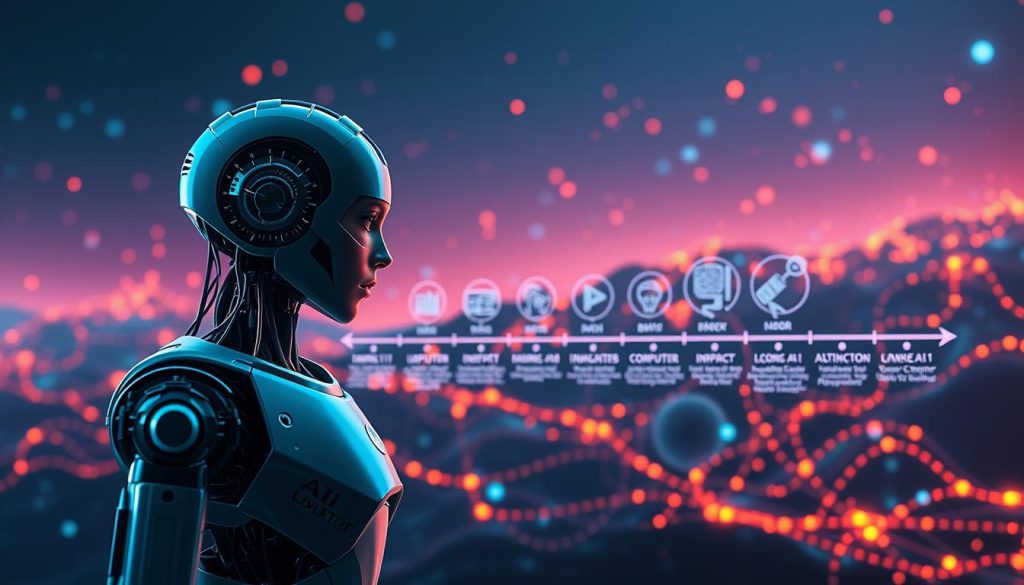
AI feedback loops are key in making AI smarter with every step. They use results to get better at future tasks. This means AI can improve on its own by using advanced self-optimization methods.
The Basics of Artificial Intelligence
At its heart, AI tries to think like humans by learning from data. It ranges from basic algorithms to advanced systems that learn on their own. This shows the goal of AI research: to create systems that can adapt and predict, not just obey commands.
From Rule-Based Systems to Machine Learning
Moving from rule-based systems to machine learning was a game-changer for AI. At first, AI could only do what it was specifically programmed for. Then, machine learning came along. It lets AI improve through data and self-optimization, letting machines better understand and interact with the world.
Key Factors Driving AI Improvement
Artificial intelligence keeps getting better, thanks to key factors. These include the data AI learns from, improvements in learning methods, and better computer power. All these elements work together to improve AI systems. They help push what AI technology can achieve even further.
AI training data is crucial for teaching AI. It provides the information AI needs to learn and adjust. How much, the variety, and the truthfulness of this data affect how well AI works. With better and more data, AI can tackle complicated tasks in the real world.
Then, better machine learning algorithms make AI smarter. These improved methods help AI learn quicker and more accurately. It’s about making existing AI better and creating new ways AI can work.
Last, computational power improvements have always pushed AI forward. Faster and more efficient computers allow for more complex AI training and applications. This means AI can evolve quickly and solve more difficult problems.
| Factor | Impact on AI Improvement |
|---|---|
| AI Training Data | Enhances learning accuracy, enables handling of more complex tasks |
| Machine Learning Algorithms | Increases efficiency and speed of AI learning processes |
| Computational Power | Supports more advanced training, fosters quicker evolution |
The Role of Deep Learning in AI Progress
The rise of AI in recent times owes much to deep learning progress. Deep learning, a part of machine learning, uses complex neural networks. It has changed how we handle data and automation.
Neural networks are at the heart of deep learning. They’re built like the human brain. They let machines learn from loads of data. This learning powers things like voice recognition and self-driving cars.

Deep learning uses big, linked layers of algorithms called neural networks. These networks get better as they take in new data. They somewhat think like us but in a simpler way. This boosts improvement in language translation, recognizing objects, and playing strategic games.
- Neural Networks Function: Neural networks mimic the human brain to spot patterns in data better than old models could.
- Applications of Deep Learning: Deep learning boosts lots of products and health diagnoses. It’s behind smarter phone helpers and more exact medical tests.
Deep learning’s uses keep growing. In healthcare, it predicts patient results better. In cars, it makes self-driving safer. This shows how deep learning, with its neural networks, pushes machine learning forward. It brings us closer to creating intelligent systems once thought impossible.
Feedback Loops: Learning from Experience
AI advancements rely heavily on AI feedback loops. These are key to helping systems learn and get better by themselves. Each time AI interacts with its environment, it collects new information. This process is crucial for developing smarter AI behaviors.
Reinforcement Learning Explained
Reinforcement learning is a main method in AI. It helps systems learn from successes and mistakes, improving over time. Unlike other learning methods, it places AI in a changing environment. Here, AI acts, gets feedback, and uses this information for future actions. This way, AI can improve and adapt without needing human guidance.
Real-World Examples of Feedback Loops
AI feedback loops are being used in many areas, from aviation to cars, to make things safer and more efficient. For example, in aviation, AI helps set prices for flights. It also keeps airports running smoothly. This ensures that resources are used well and passengers have a good experience.

Self-driving cars are another area where these loops make a big difference. By continuously getting data from their surroundings, these cars fine-tune their driving. This makes them safer and better at navigating. These examples show how AI feedback loops are changing a variety of industries.
| Industry | Application of AI Feedback Loops |
|---|---|
| Aviation | Optimization of flight paths and pricing strategies |
| Automotive | Enhancement of autonomous vehicle navigation and safety protocols |
| Retail | Customization of customer experiences and inventory management |
The examples mentioned show that AI feedback loops and iterative learning processes are more than tech terms. They are essential for making improvements and bringing new ideas to life in many areas.
The Impact of Human Expertise on AI Development
Human knowledge and artificial intelligence (AI) are key in making AI better. By working together, humans help improve AI, making sure it works well and stays ethical. This partnership boosts AI’s performance and helps it deal with complex issues.
Collaborative AI merges human intelligence with AI’s speed. This blend leads to smarter, more aware AI tools. These tools fill in gaps that AI can’t manage alone.
Humans and AI working together lead to breakthroughs in many fields. Looking at specific cases shows how this teamwork changes professional methods and creates new paths for growth.

When experts help shape AI, the technology gets better faster. This team effort makes AI more practical and relevant. Here are a few key examples of AI co-creation success:
- AI helps pilots tackle difficult flight patterns and navigation problems.
- Judicial AI tools assist in evaluating cases and predicting outcomes.
- Social media algorithms understand trends and suggest content more effectively.
These examples show the benefits of combining human skill with AI. Such teamwork not only makes the tech better but also more useful every day. This progress points to even more AI advances in the future.
Ethical Considerations in AI Improvement
As AI technologies grow and move closer into our lives, it’s important to focus on ethical AI. We must make AI systems that are not just efficient but also ethical. This helps in preventing misuse and ensuring fairness. Tackling AI bias and improving algorithm accuracy are key for responsible AI development.
When refining algorithms, it’s critical to review how AI systems make decisions. Ethical AI must create fair algorithms and care for everyone’s welfare. Adding transparency and accountability to AI can lessen risks and increase AI’s benefits.
Addressing AI bias is vital for creating fair AI systems. They should not add to existing inequalities. Using diverse data sets and monitoring for bias helps. Working with ethicists and sociologists can also enhance AI’s ethical standards.
Here is a summary that shows how to encourage ethical AI with responsible practices:
| Focus Area | Description | Impact |
|---|---|---|
| Data Diversity | Incorporation of diverse data sets to mitigate AI bias. | Reduces risk of biased outcomes and increases system fairness. |
| Algorithm Transparency | Clear documentation and explanation of how AI algorithms make decisions. | Enhances trust and accountability in AI applications. |
| Ethics Integration | Engagement with ethical experts during AI system design. | Fosters broader societal acceptance and ethical compliance. |
This table stresses the importance of ethical thinking in AI development. Ethical AI focuses on human welfare and ensures technology grows with societal values. Thus, AI can support societal good instead of causing more inequality.
Future Prospects of AI Improvement
The future of AI is a hot topic for tech experts and businesses. We are moving towards a new decade, and AI’s path is expected to change technology in big ways. This change will be fueled by emerging AI technologies and big growth in the AI market.
Experts predict AI will soon mimic human intelligence more closely. This advancement could change many fields, like healthcare and cars, changing how society works.
- Machine learning models are getting better at understanding big data, helping to make smart decisions quicker.
- Advancements in how machines process human language will continue, expanding AI’s role in everyday tech.
- AI-driven biotech innovations promise to change medicine in ways we used to think were only possible in sci-fi.
AI’s growth across different areas shows a strong future filled with innovation. The future of AI is about more than smart programs. It’s about building a partnership between people and machines. This combination of emerging AI technologies and old industries promises a future that’s better, efficient, and good for the economy.
The Importance of Continuous Learning
As technology grows, AI’s ability to keep learning becomes key to its success. Lifelong learning lets AI systems adjust to new changes. They use self-optimization and adaptive algorithms to keep improving.
Adaptive AI algorithms let AI change its functions based on new info without humans. These algorithms help AI systems react to changes quickly, improving their performance. AI becomes more accurate and useful in many fields thanks to this.
In sectors like healthcare and education, these technologies make a big difference. In healthcare, they improve how we diagnose and plan treatments. In education, they create custom learning experiences for each student.
| Industry | Application of Adaptive AI | Impact |
|---|---|---|
| Healthcare | Enhanced diagnostic accuracy | Improved patient outcomes |
| Education | Personalized learning paths | Increased engagement and retention |
| Finance | Risk assessment and management | Reduced errors and better decision-making |
Adaptive AI and self-optimization make AI systems learn from the past and prepare for the future. This continuous learning builds a strong framework for AI. It keeps growing, always searching for new knowledge and ways to get better.
Conclusion: The Continuous Journey of AI Evolution
When we think about artificial intelligence, we realize AI’s growth is endless. It’s a journey, not a destination. This journey is powered by the steady improvement of technology. Technologies get better thanks to better AI training and self-improvement methods.
This has moved AI from simple beginnings to advanced systems that can beat human skills in some areas. As AI becomes a bigger part of our lives, we need to embrace its future. Doing so keeps us ahead in innovation.
Embracing the Future of Artificial Intelligence
AI can greatly improve how we solve problems and make decisions. This opens incredible chances in many areas. Industries are changing, using AI to grow and create new types of businesses.
As we see these shifts, it’s important to think about ethics and growing AI expertise. We must keep our human values while using these advanced systems.
Preparing for a Changing Landscape
We must work together globally to regulate AI and set standards. It’s key to have data scientists, ethicists, and policymakers work together. They will help shape a future that fits our ethical and economic needs.
By using AI training data for good, making learning processes more efficient, and improving self-optimization, we can build a future. In this future, AI helps us all achieve more.
FAQ
How Does AI Improve Over Time?
What Are the Basics of Artificial Intelligence?
How Have AI Systems Transitioned from Rule-Based Systems to Machine Learning?
How Do Data Availability and Quality Drive AI Improvement?
What Advances Have Occurred in Machine Learning Algorithms?
How Have Computing Power Enhancements Contributed to AI Progress?
How Do Neural Networks Function Within Deep Learning?
What Are Some Applications of Deep Learning?
What Is Reinforcement Learning and How Does It Work?
Can You Provide Real-World Examples of Feedback Loops in AI?
How Does Collaborative AI Enhance Human Expertise?
What Are Some Case Studies of AI Co-Creation?
Why Is Balancing Advancement with Responsibility Important in AI?
How Can Bias in AI Algorithms Be Addressed?
What Predictions Are There for AI in the Next Decade?
What Emerging Technologies Are Influencing AI?
Why Is Lifelong Learning Important for AI Systems?
How Are Adaptive Algorithms Applied in Different Industries?
What Does the Future Hold for Artificial Intelligence?
How Should We Prepare for the Impact of AI on the Socio-Economic Landscape?
About the author : virtual-glasses